Shockwave Therapy for ED: How Many Applicators You Actually Need
Clinics that add a shockwave service usually start the same way: they compare consoles on energy range, then realise the energy range was never the constraint. The constraint is the applicator set. A device with a narrow head selection forces the operator to use the wrong geometry on whole categories of cases, and no amount of output range compensates for that.
That is why the head count deserves to be the first line of the specification you compare. This is a practical look at what a shockwave therapy for ED service needs from the device, how many applicators that actually implies, and which head goes with which treatment part.
What a shockwave therapy for ED service needs from the device
A shockwave therapy for ED service is not a separate machine category. It runs on the same console as the orthopaedic list, which is precisely why the equipment decision is worth getting right: the device has to serve two caseloads with one purchase.
Three requirements come out of that:
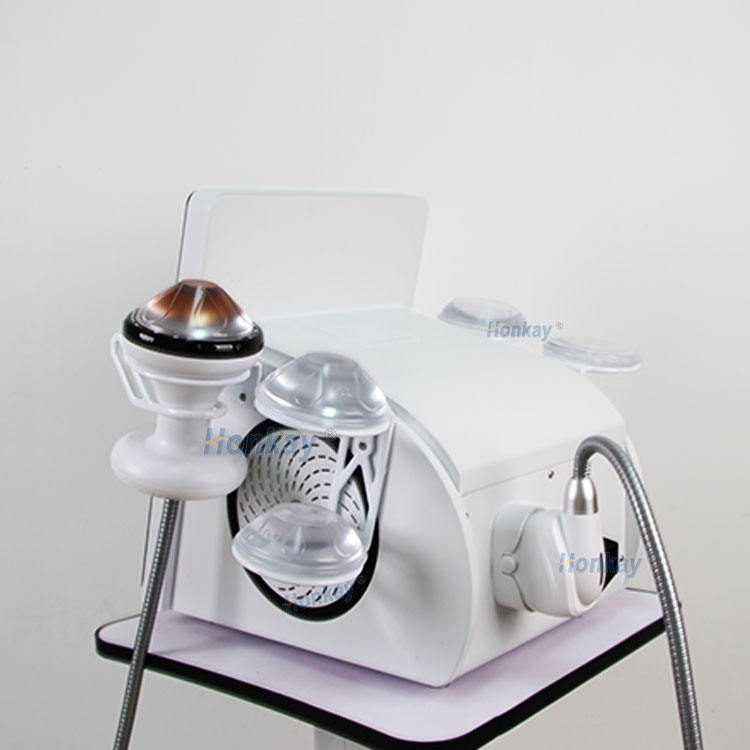
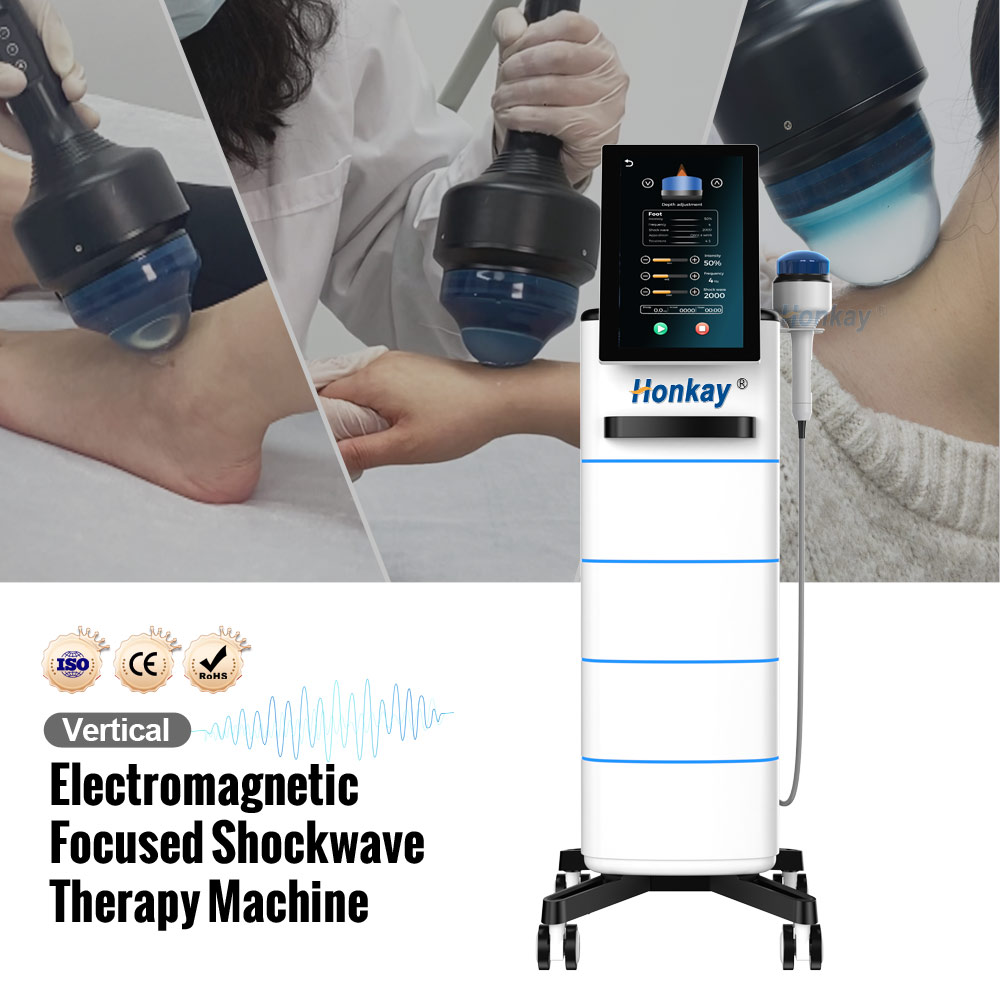
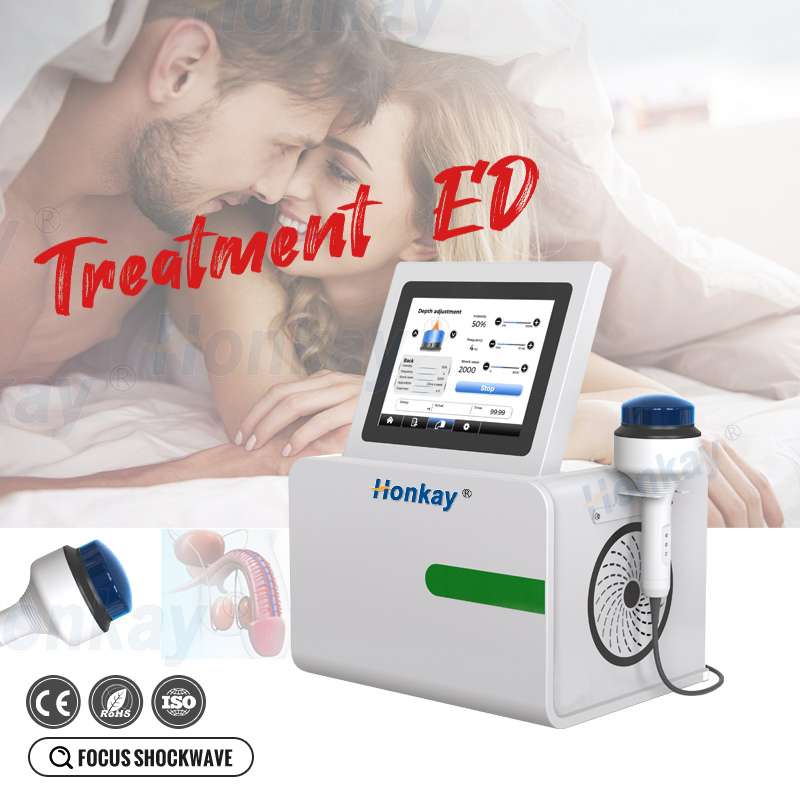
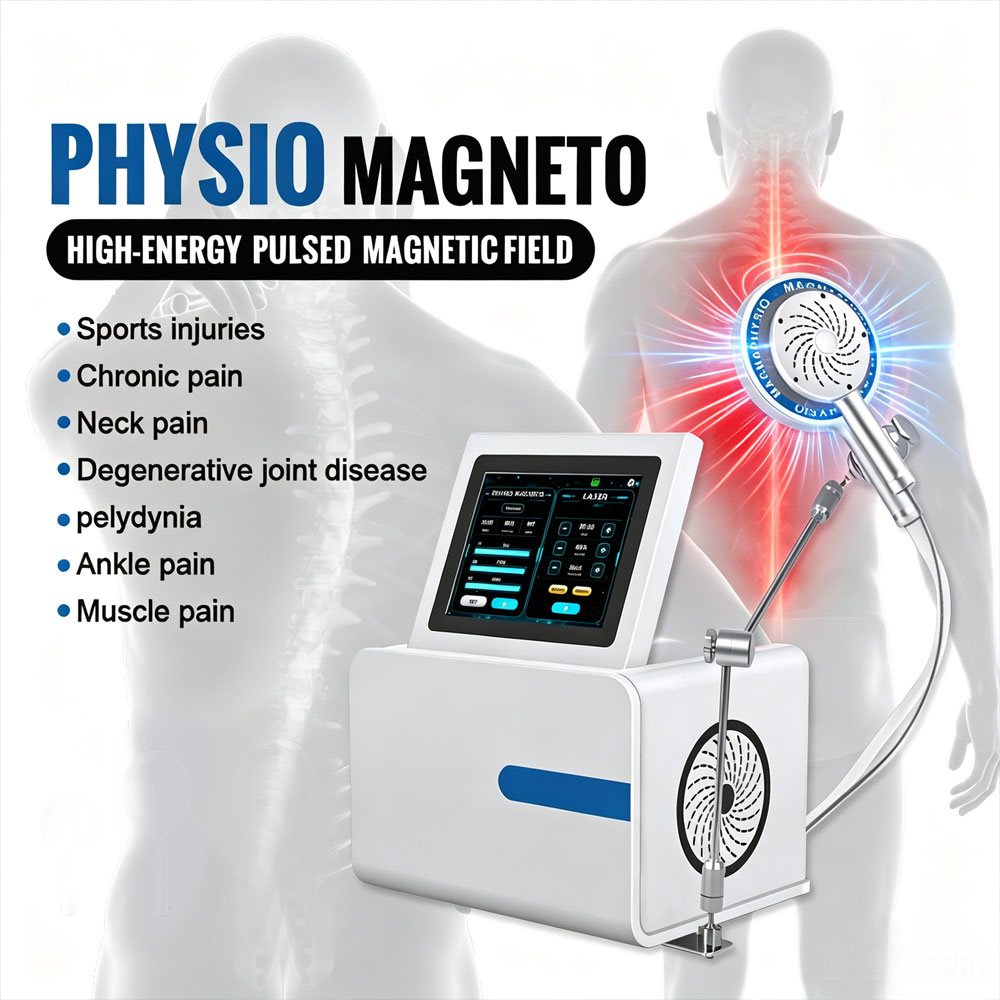
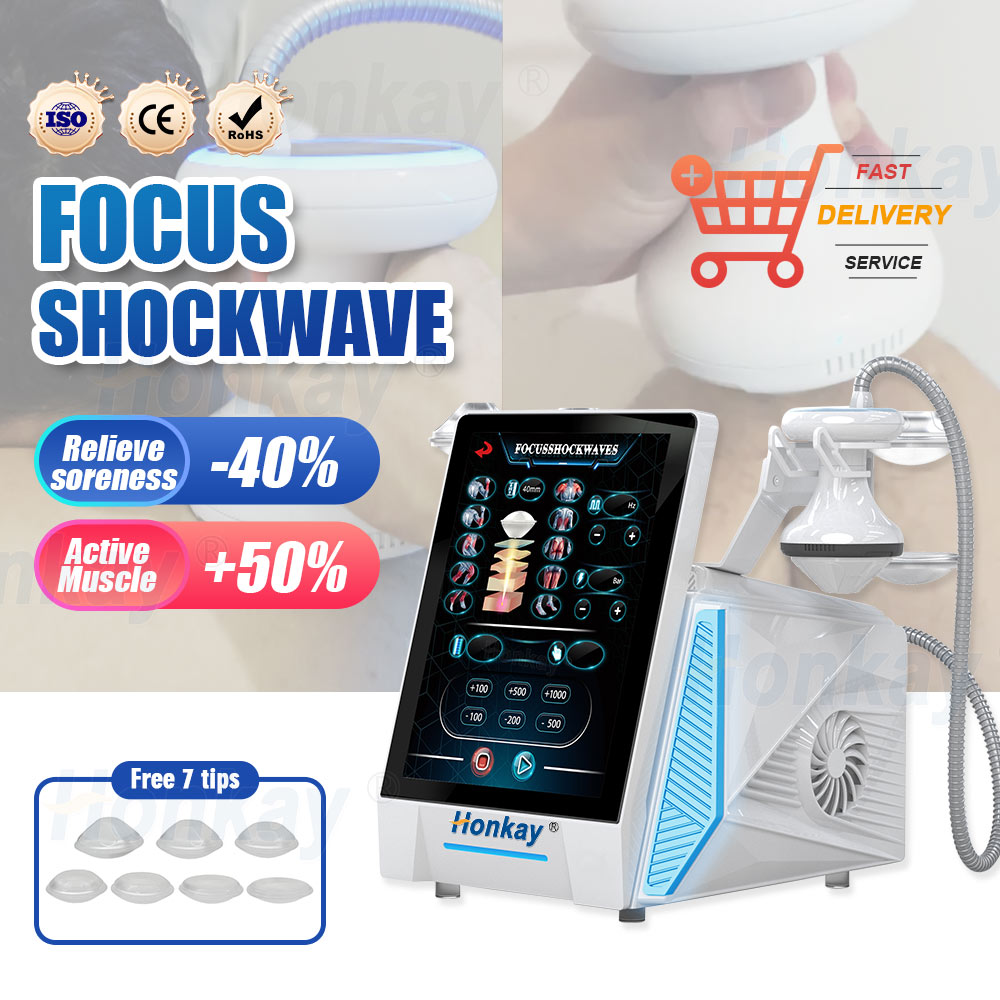
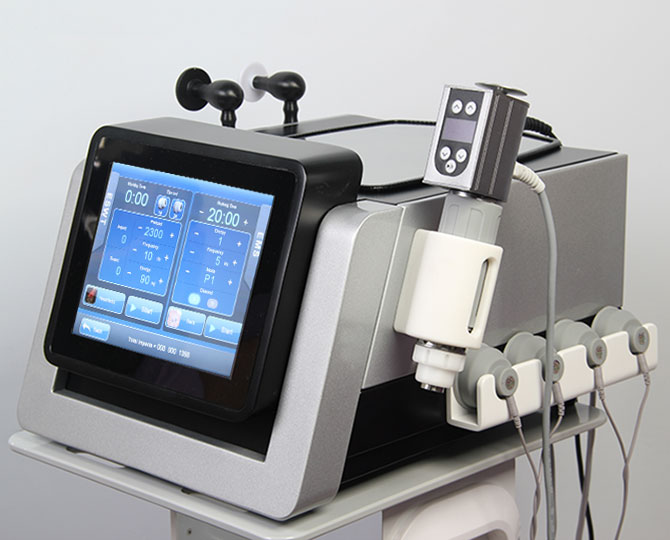
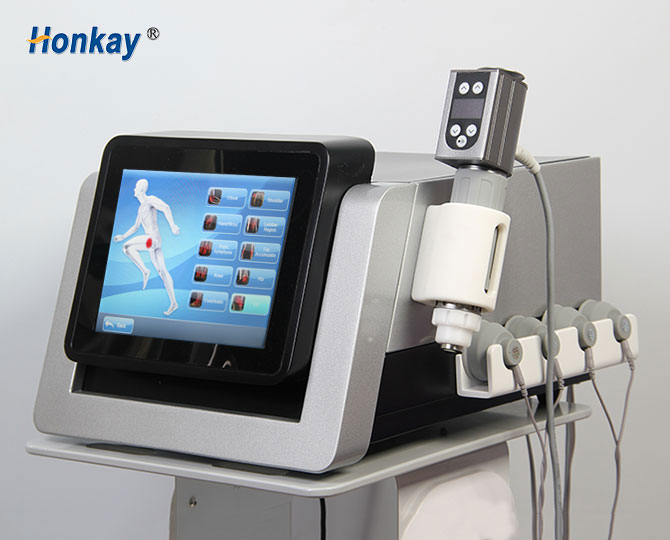
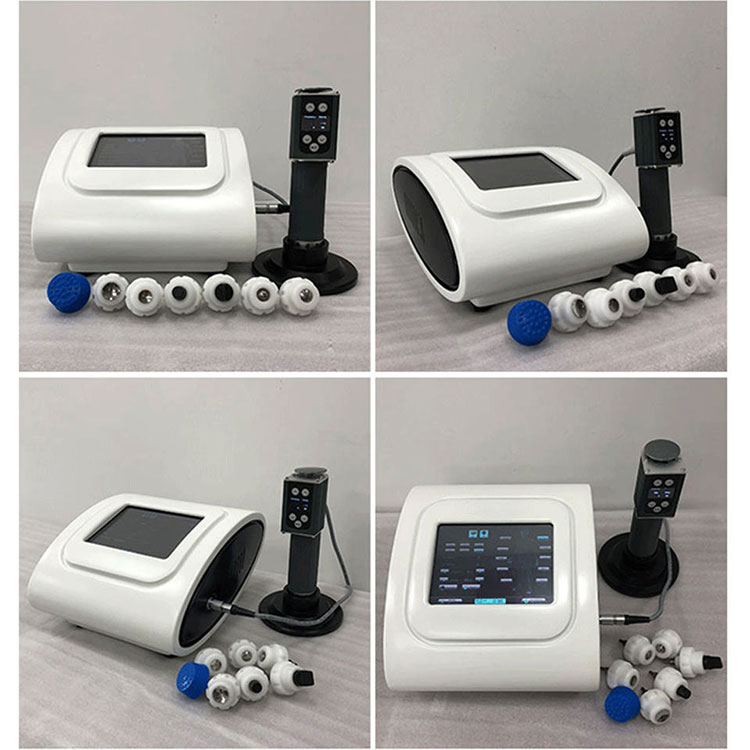
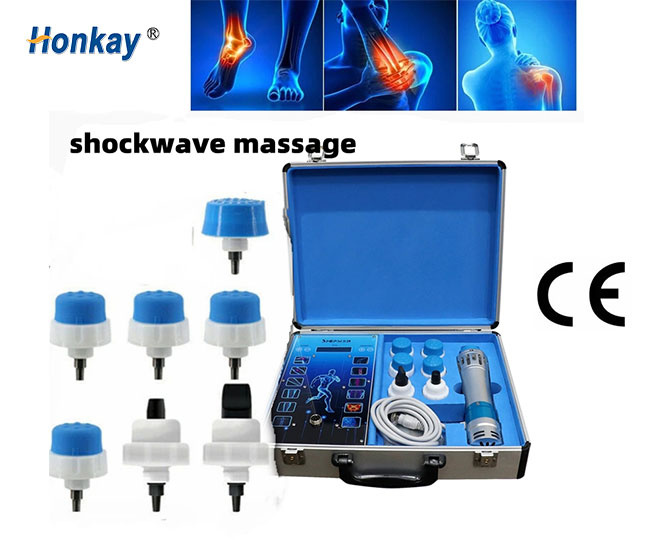
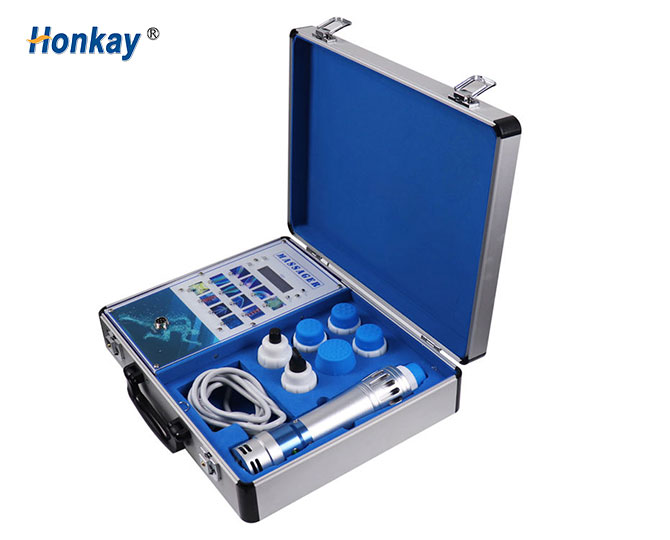
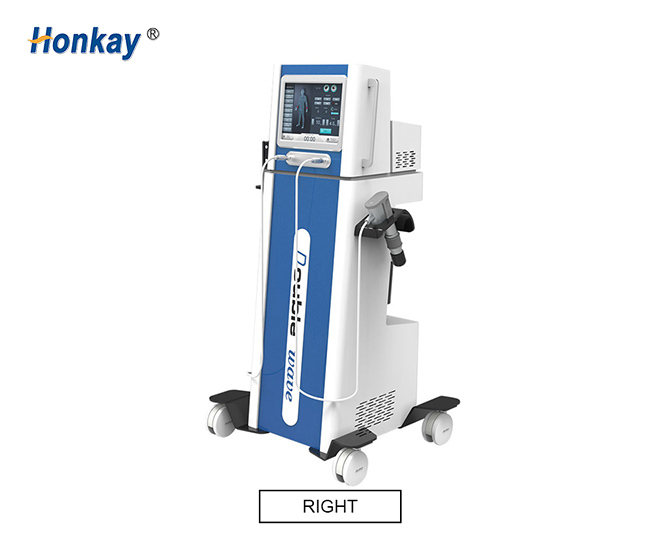
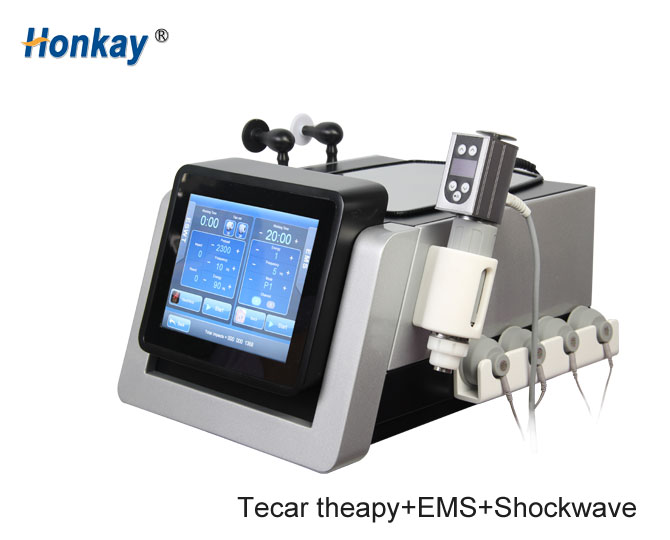
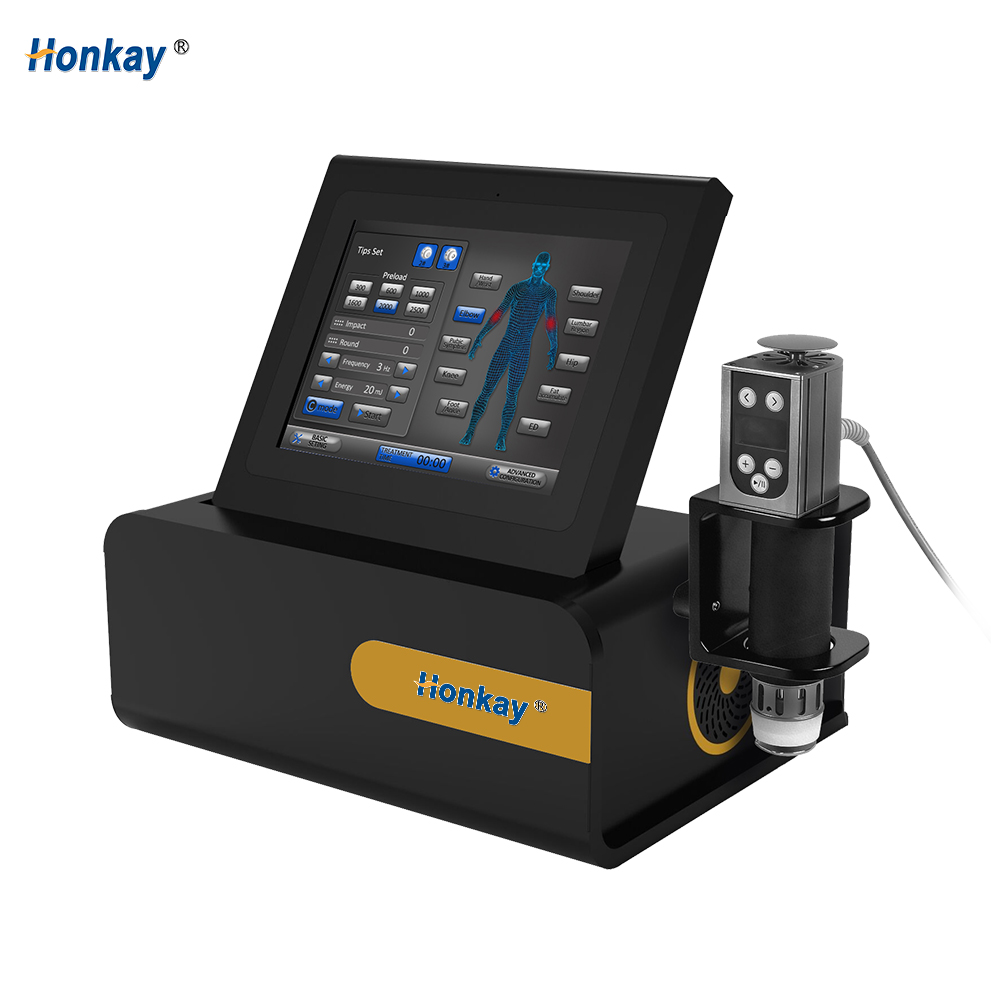
- Dedicated applicators for the ED indication. A general-purpose body head is not shaped for it. Devices built for this market ship specific heads for the indication — the unit pictured carries seven heads, two of which are dedicated to it.
- An energy range wide enough for both ends of the list. The painful-heel and tendon cases sit at the lower end; the deep orthopaedic work sits higher. A range of 5–200 mJ covers both, and the operator needs usable settings in between rather than only at the extremes.
- A preload or intensity stepping system you can reproduce. This platform uses preload values of 300, 600, 1000, 1600, 2000 and 2500, which is what makes a protocol repeatable across different operators on different days.
Notice that none of those three is “more power”. The list is applicator geometry, usable range, and reproducibility.
The applicator set: how head count decides coverage
Head count is not a marketing number. It is a statement about how many distinct tissue targets the device can address properly.
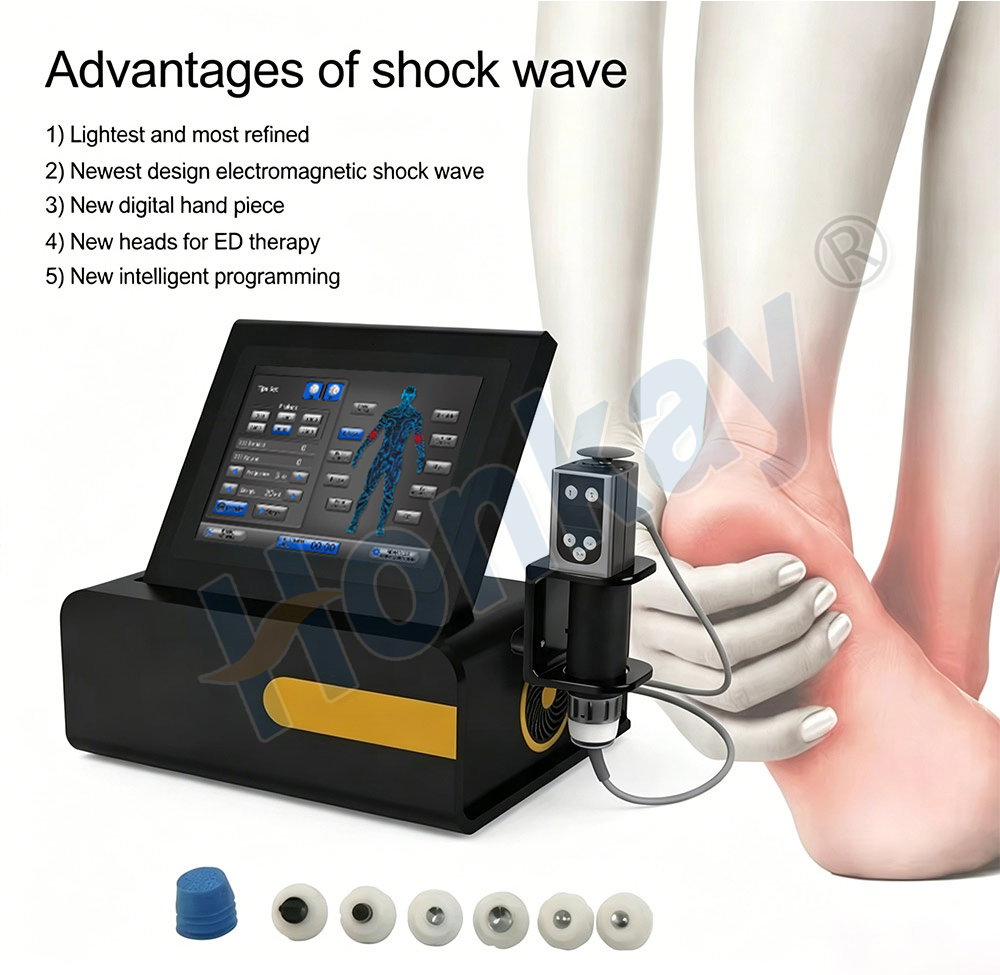
A seven-head set maps to a real clinical spread rather than a single indication:
- Broad body heads for large muscle groups and back or thigh work, where coverage per pass matters more than pinpoint accuracy.
- Smaller, focused heads for tendon insertions, elbows, heels and other targets where the energy has to land on a defined structure.
- Dedicated heads for the ED indication, which is where a general-purpose device usually falls short.
The practical consequence is throughput. If two heads cover your whole list, you will be swapping them mid-session and cleaning between patients. If the set covers the list, each session starts with the right geometry already on the handpiece.
Choosing the right head for the treatment part
The treatment list for this class of device is broad but not random. Each entry asks for a particular geometry.
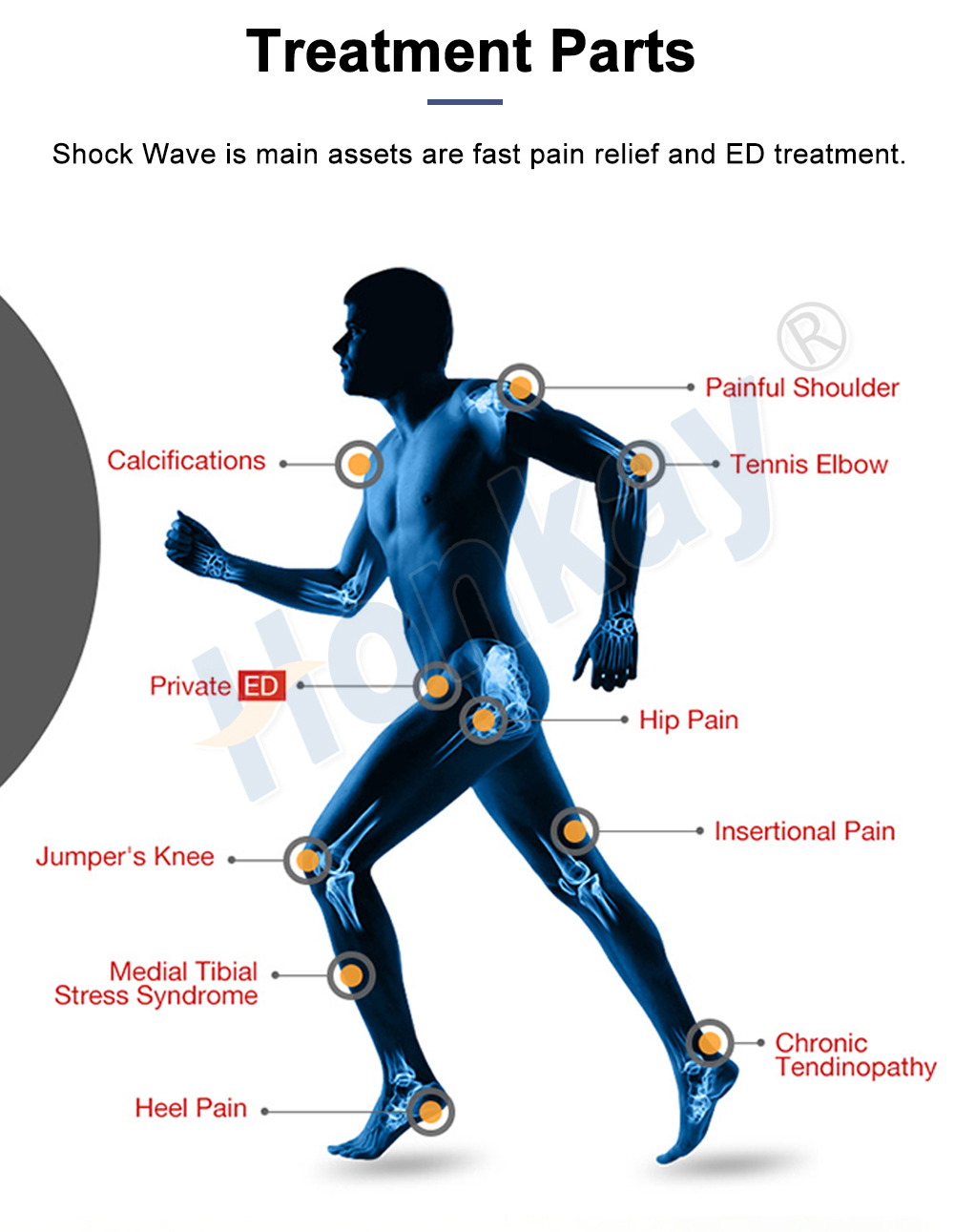
| Treatment part | What it asks of the applicator |
|---|---|
| Painful shoulder, hip pain | A head that holds a stable position over a thick soft-tissue layer; depth matters more than surface area |
| Tennis elbow, insertional pain | A small contact area that can be placed precisely on a tendon insertion and held there |
| Calcifications | Consistent energy delivery to a defined point rather than a spread over a region |
| Jumper’s knee, chronic tendinopathy | A focused head used at intermediate settings, repeated on the same defined target each session |
| Heel pain, medial tibial stress syndrome | A small, well-supported head on a curved surface, run for a full pulse count without drifting |
| Back and thigh work | A broad head for coverage, where treating the region matters more than pinpointing a structure |
| ED indication | The dedicated heads supplied for that purpose — not a repurposed body head |
Read down that column and the seven-head logic becomes obvious: the set is a coverage map, not an accessory list. A clinic that treats heels and elbows needs small focused heads; a clinic doing broad muscle work needs large ones; a clinic offering ED treatment needs those specific heads on the shelf.
The session workflow, step by step
Whatever the indication, the sequence is the same, and the equipment should make it short.
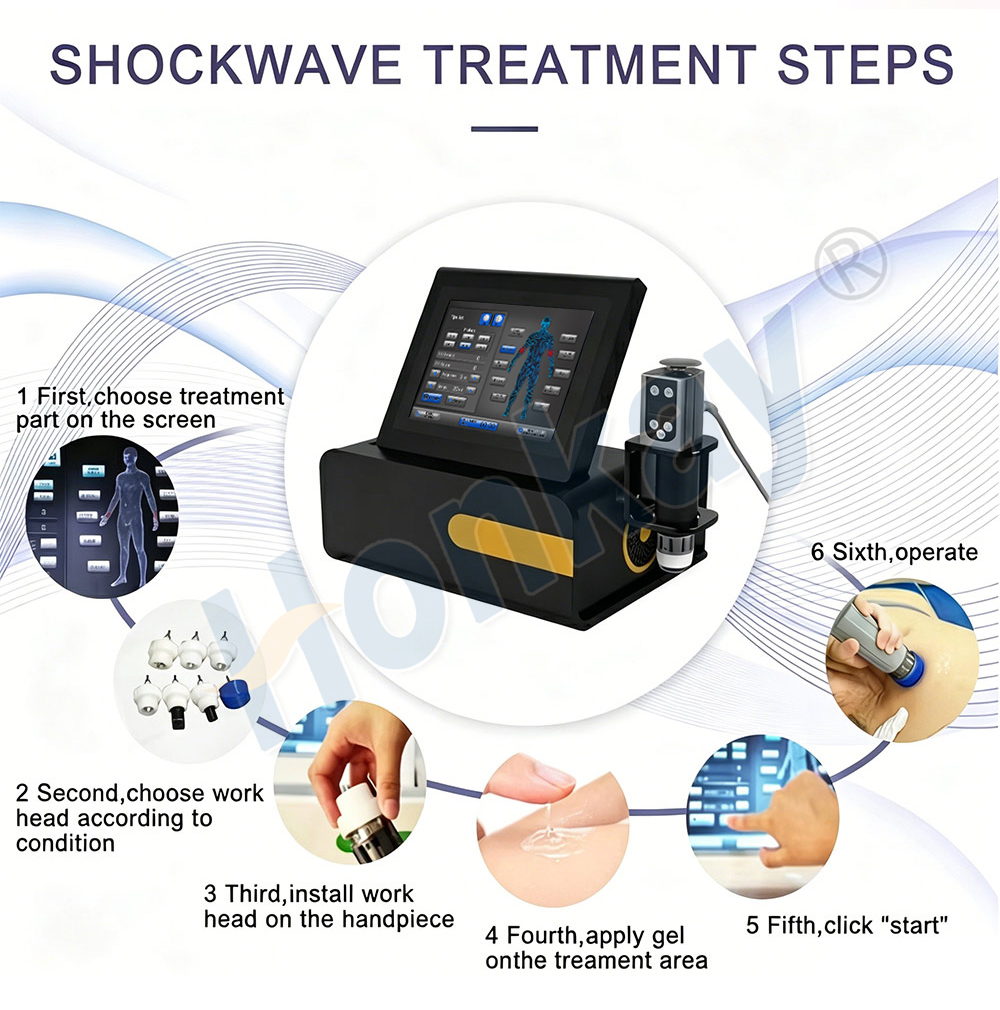
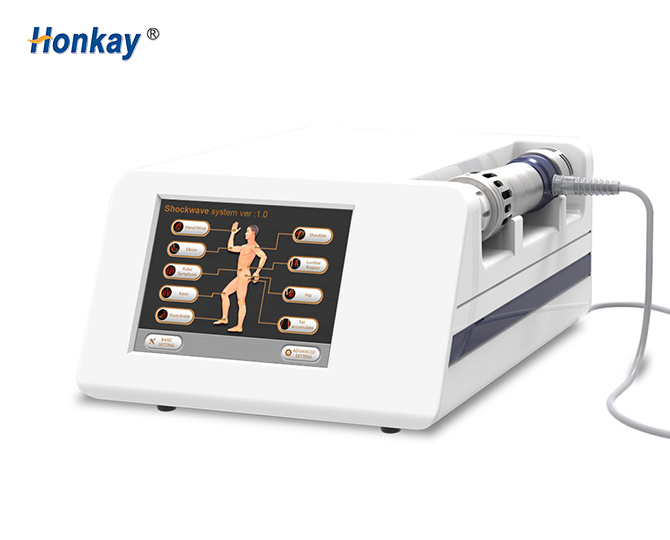
- Select the treatment part on the controller. A body-map interface is faster than a menu tree, and it documents which area was treated.
- Choose the work head for the condition. This is the decision the applicator set exists to make easy.
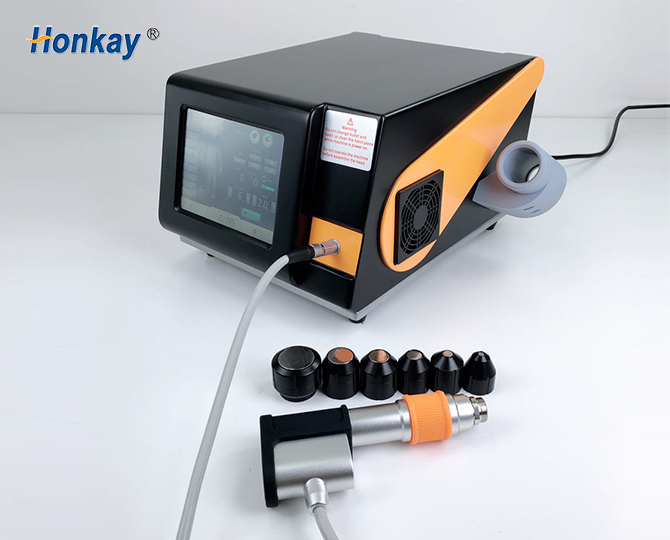
- Install the head on the handpiece. A digital handpiece with an intensity control on it lets the operator adjust during the session without returning to the console.
- Apply gel to the treatment area. Coupling medium is used per session, so budget for it and keep it within reach.
- Start the programme. Stored parameters are what make step 1 and step 2 repeatable rather than approximate.
- Operate. Session length per area is short, and the pulse counter tells you what was actually delivered.
Two practical notes on that sequence. First, gel is the one recurring consumable in this workflow, so confirm what the supplier recommends rather than assuming. Second, the operator should be able to complete steps 1 to 5 in under a minute — if a standard session takes longer to set up than to deliver, the device is slowing the clinic down.
Screening and contraindications: where the equipment duty ends
The equipment side of an ED service is easier to get right than the clinical side, and the difference matters more here than on an orthopaedic list. A device is a tool; the decision to treat a particular patient is a clinical one, and the machine has no part in it.
Two consequences for whoever buys the equipment:
- The screening step is not optional and not a formality. Standard exclusions for this modality include implanted electronic devices, pregnancy, tumours in the treatment area, local infection, anticoagulant therapy, and metal implants where vibration could damage surrounding tissue. Cases that fall outside the service should be referred, not treated.
- The operating scope is a local question. Who is permitted to deliver this treatment, and under what supervision, differs by country and often by region. Confirm that before the device is ordered, because it determines what your service can actually offer and which staff will operate it.
If a supplier cannot provide a written contraindication list, protocol table and operating documentation with the machine, that is a gap in the offer rather than a detail.
Specifications to confirm in writing
| Confirm | Why it matters |
|---|---|
| Number of treatment heads and which indications each serves | Head count is the coverage decision, not an accessory count |
| Which heads are dedicated to the ED indication | A repurposed body head is not equivalent |
| Energy range and its unit | Reproducing a protocol requires a stated range and unit |
| Preload / intensity steps available | The stepping system is what makes a protocol repeatable |
| Pulse frequency range | Must cover the protocols you intend to run |
| Session timer and pulse counter | Needed for repeatable sessions and for logging |
| Handpiece control layout | On-handpiece adjustment avoids trips back to the console |
| Consumables per session | Coupling medium is the usual recurring item; confirm what is required |
| Screening and contraindication list | A written list, supplied with the machine |
| Protocol documentation per area | Ask for the table, not a marketing page |
| Warranty terms | Period and scope; ask for it in writing |
| Training and after-sales route | Named in the purchase, with a contact and a response expectation |
Frequently asked questions
How many applicators does a shockwave device need for an ED service?
Enough to cover both caseloads without swapping mid-session. In practice that means one or two dedicated heads for the ED indication plus a spread of body heads for the orthopaedic list — seven heads in total is a realistic set for a clinic running both. Fewer heads does not make the device unusable, but it does mean every session starts with a swap and a clean.
Can the same heads be used for orthopaedic cases and the ED indication?
Not optimally. The heads supplied for the ED indication are shaped for that purpose, and a broad body head is a poor substitute — it is the wrong geometry for the target. When heads are supplied for the indication, use them for it and keep the body heads for the orthopaedic list.
What energy range and stepping system should I look for?
A range wide enough for both ends of your list — 5–200 mJ covers painful heels and tendon work at the lower end and deeper orthopaedic work above it. Then look at the stepping system: values such as 300, 600, 1000, 1600, 2000 and 2500 are what make a protocol reproducible, because two operators can return to the same setting rather than approximating it.
What does a standard session involve, start to finish?
Select the treatment part on the controller, choose the work head for the condition, install it on the handpiece, apply coupling gel to the area, start the stored programme and operate. Per-area delivery time is short; the setup should be shorter.
What consumables does each session require?
Coupling gel is the recurring item, since the head has to couple to the skin. Everything else in the workflow is reusable. Ask the supplier what they recommend and what a session actually requires rather than assuming, and include the gel in your running cost estimate.
What screening has to happen before a patient is treated?
A screening step against a written contraindication list. Standard exclusions for this modality include implanted electronic devices, pregnancy, tumours in the treatment area, local infection, anticoagulant therapy and metal implants where vibration could damage surrounding tissue. Cases outside the service should be referred rather than treated.
Is “digital control” a meaningful feature or a marketing label?
It is meaningful if it shows up as stored parameters, a pulse counter and a session timer that two operators can reproduce. It is a label if the controller only exposes a power dial. Ask for a demonstration of selecting a stored protocol and reading back what was delivered.
How do I compare two quotes for what looks like the same device?
Line them up on the applicator set first, then on the range and stepping system, then on documentation. The quote should state the number of heads and what each serves, the energy range and unit, the preload or stepping values, the frequency range, the consumables required per session, the contraindication list, the per-area protocol table, the training and after-sales route, and the warranty terms in writing. Two machines at similar prices are rarely the same machine once those lines are compared.
Request a quotation
Tell us which caseload you are building — orthopaedic only, or orthopaedic plus an ED service — and we will confirm which applicator set and configuration fits it. The quotation lists every treatment head and the indication it serves, the energy range and stepping values, the consumables a session requires, the per-area protocol table, the screening list, the training and after-sales route, and the warranty terms in writing.
Manager: Lisa
WhatsApp: +8613751821215
E-mail: hk6@huang-kai.com