Focused Shockwave Therapy: How Depth and Mechanism Decide What You Can Treat
Two machines can both be sold as “shockwave” and treat different patients. The distinction is not power. It is whether the energy is delivered as a focused pulse that converges at depth, or as a radial wave that spreads from the applicator surface. That single design difference decides which tissues you can reach, and therefore which cases you can accept.
Focused shockwave therapy concentrates the pulse so that its maximum effect sits below the skin, at a depth the operator selects. Radial devices deliver their peak at the surface and fall away from there. For superficial trigger points the difference is academic. For a tendon insertion, a bone-tendon junction or a chronic deep structure, it is the whole question.
Focused and radial are different mechanisms, not two power settings
The comparison most buyers are shown is a power comparison. It should be a penetration and localisation comparison, because that is what changes the caseload.
| Focused shockwave | Radial shockwave | |
|---|---|---|
| Where the peak energy sits | Converges below the surface, at a chosen depth | At the applicator contact point, spreading outward |
| Target tissue | Tendon insertions, bone-tendon junctions, deeper structures | Superficial muscle, trigger points, broad areas |
| Localisation | Concentrated — treats a defined point | Diffuse — treats a region |
| Best fit | Chronic tendon and bone-adjacent conditions | Muscle work, myofascial release, larger areas |
| Depth control | Adjustable on the unit | Fixed by the applicator design |
A clinic treating chronic tendon cases with a radial device is not underpowered — it is treating at the wrong depth. That is why the two technologies are complements rather than competitors, and why a device that lets you set the depth is worth more than one with a bigger maximum output.
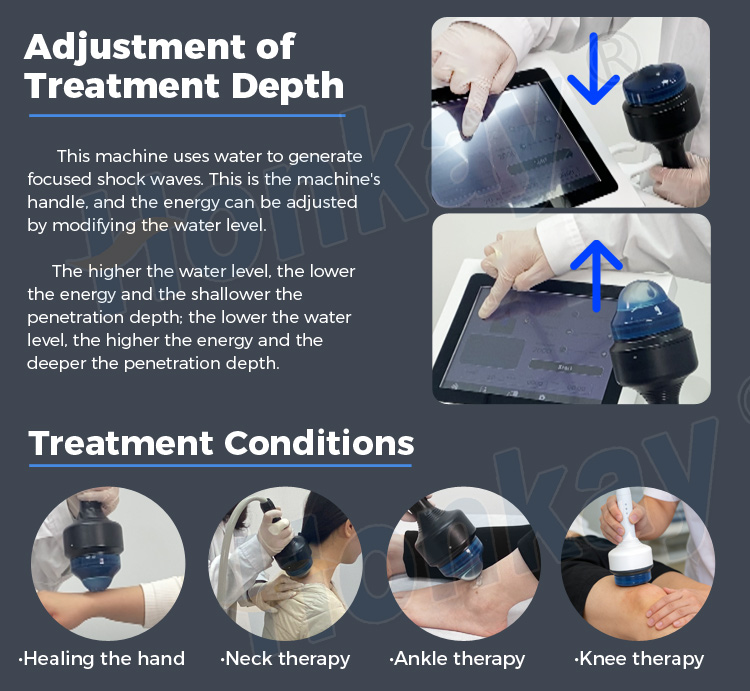
How the depth setting actually works on a water-based head
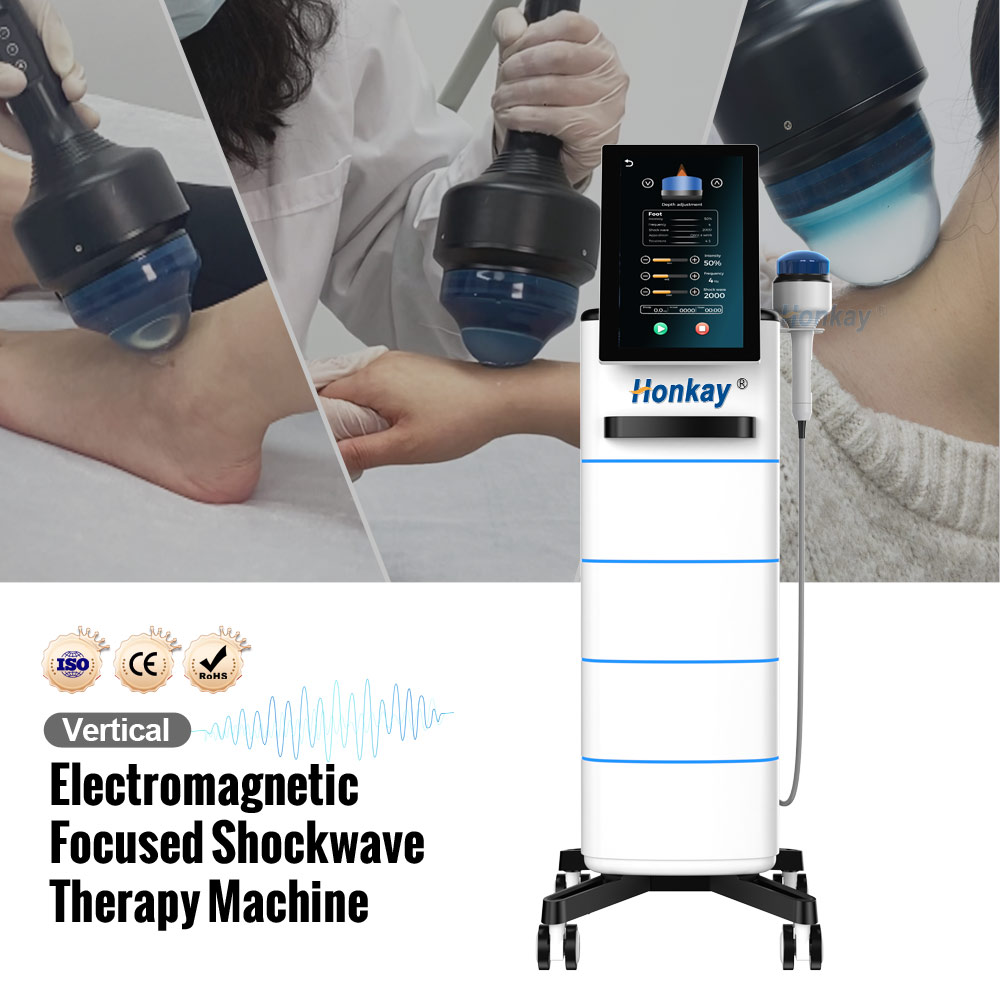
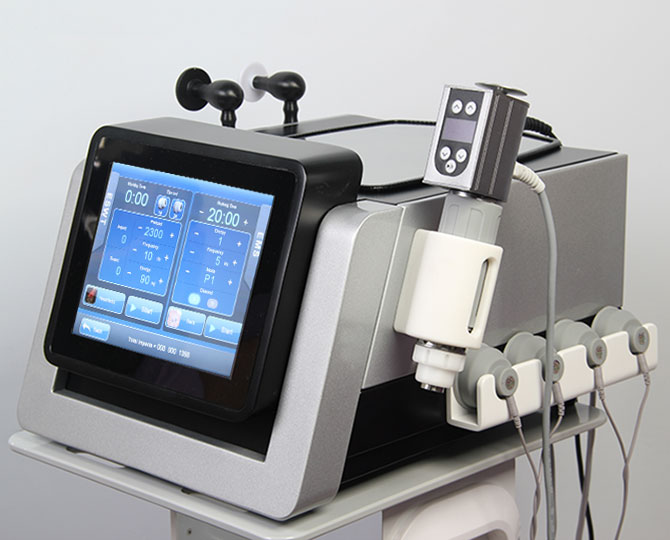
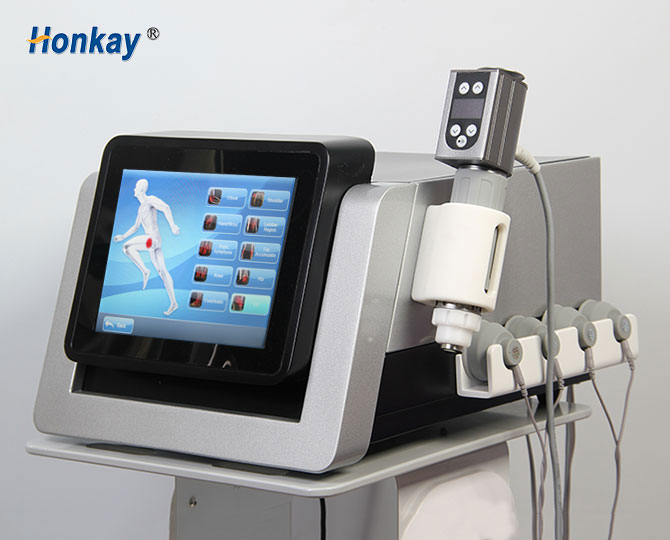
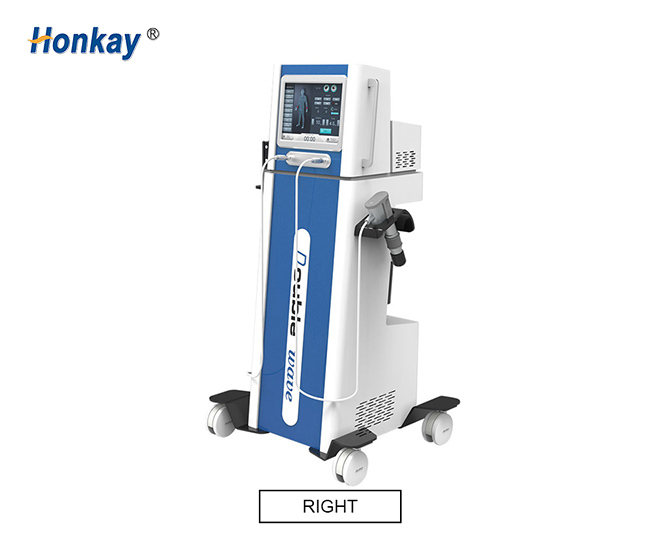
On an electromagnetic focused unit, the pulse is generated in the applicator and coupled into tissue through a water column inside the handpiece. That is why the depth control is mechanical rather than electronic: raising the water level lowers the energy and makes the penetration shallower; lowering the water level raises the energy and drives the pulse deeper.
Two practical consequences follow, and both catch buyers out:
- “Maximum energy” is not the only useful setting. A shallow, lower-energy setting is what you want over a bony prominence or a thin, sensitive area. A machine that only performs at full output is a machine you will not use on half your list.
- Depth is a clinical decision the operator makes per patient, not a fixed property of the device. Ask a supplier to demonstrate the adjustment range across its full travel, not just at the two extremes.
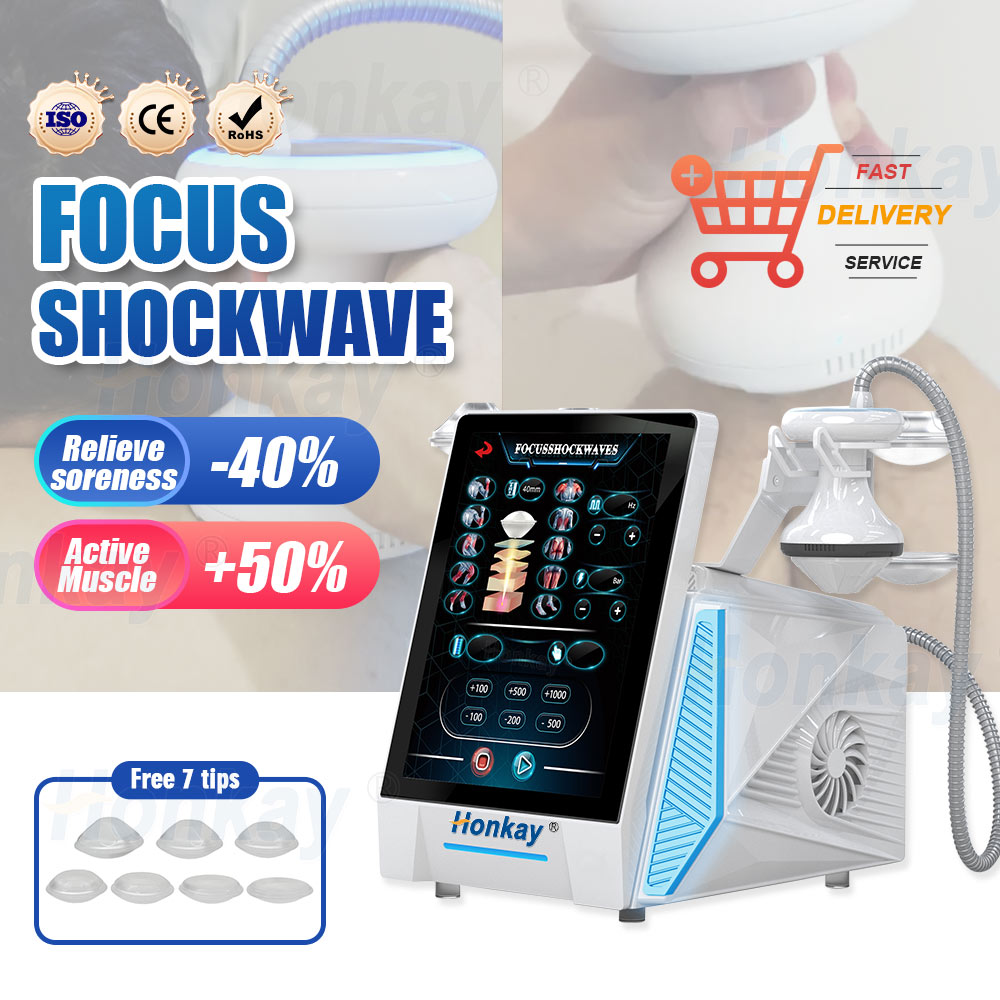
The same head carries the intensity control and the pulse counter, and the treatment itself needs no gel pad and no disposable coupling medium — the coupling is internal. That removes a consumable from every session, which on a busy list is a recurring cost line rather than a one-off.
Focused shockwave therapy vs radial: the one axis that matters
Put the two applicators side by side on the same limb and the difference is visible. The focused head delivers a converging pulse that reaches the bone-tendon junction; the radial head delivers its energy into the muscle mass nearer the surface and dissipates from there.
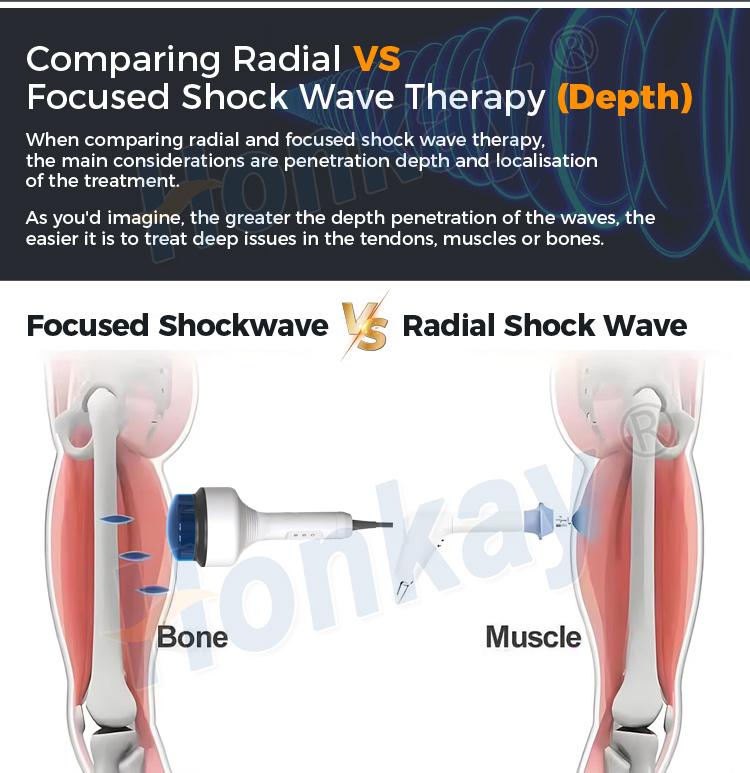
Read that diagram against a caseload and the buying decision becomes concrete:
- Plantar heel pain, Achilles insertional problems, tennis elbow, calcific shoulder, jumper’s knee — conditions where the pathology sits at a tendon or bone-tendon boundary. These are focused-indication cases.
- Broad myofascial tightness, post-exercise muscle soreness, larger muscle groups — radial territory, where a diffuse wave over a surface area is the point rather than a drawback.
- Both in one clinic — common in sports rehabilitation, where the same patient may need deep tendon work and superficial muscle work in one course.
The practical conclusion is not “buy focused instead of radial”. It is that a focused unit covers the deep, localised cases that a radial unit cannot reach, so a clinic that treats chronic tendon problems should be clear about which technology it is buying — and should not accept a power figure as evidence either way.
What to look at besides the mechanism
Once the mechanism is settled, the remaining differences are the ones that decide whether the machine is pleasant to own.
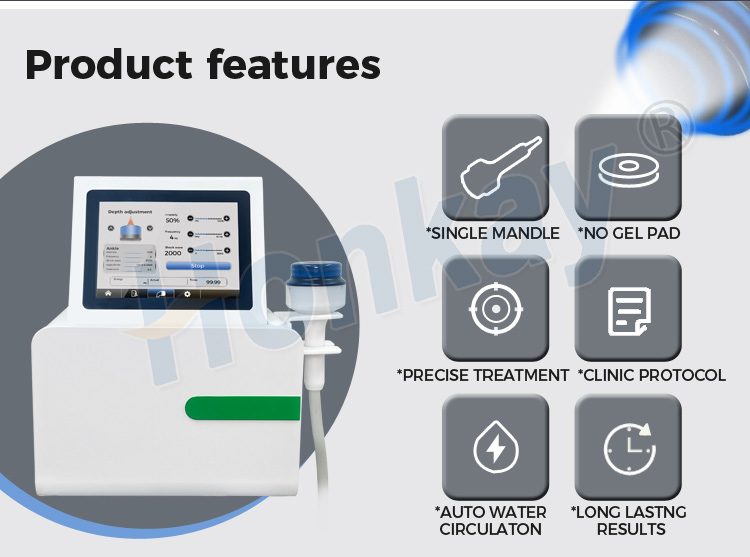
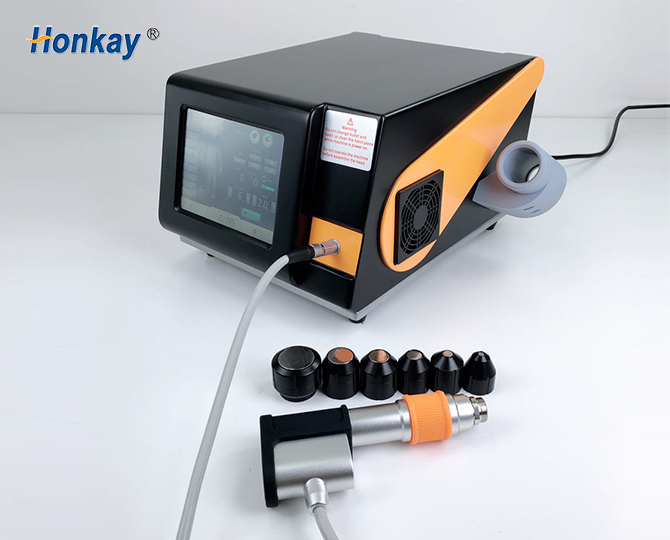
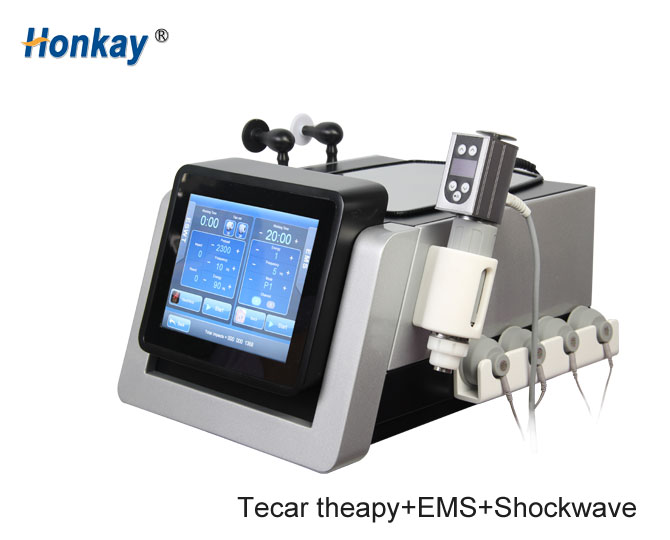
- One handpiece. No interchangeable heads to lose or replace, and no per-head consumable. Application depth is set on the unit rather than by swapping an insert.
- No gel pad. Coupling is internal, so there is no consumable and nothing to restock between patients.
- Automatic water circulation. The coupling medium is conditioned by the machine rather than by the operator, which matters for repeatability across a day’s list.
- Built-in protocols. Preset parameters for the common presentations ship with the controller, which shortens the learning curve for a new operator.
- Externally applied, drug-free. This is a non-invasive modality, and it is usually offered alongside other extracorporeal shockwave therapy equipment in a sports or rehabilitation setting rather than replacing it.
Specifications to confirm in writing
| Confirm | Why |
|---|---|
| Working depth range in centimetres or millimetres | Get one figure in one unit. Sources differ between mm and cm, and a page that shows both will contradict itself |
| Adjustment method for depth | Confirm it is a full range of travel, not two preset steps |
| Energy output and how it is expressed | Ask for the unit (mJ or bar, depending on the technology) |
| Pulse frequency range | Match it against the protocols you intend to run |
| Shock counter and session timer | Needed for repeatable protocols |
| Number of handpieces and whether spares are stocked | A single-handpiece design depends on spares availability |
| Consumables required per session | Ideally none; confirm coupling method |
| Written warranty terms | Period and scope |
| Contraindication and screening list | Implanted electronic devices, pregnancy, tumours in the treatment area, local infection, anticoagulant therapy, areas over metal implants |
| Training and protocol documentation | Named in the purchase, not sold separately |
Frequently asked questions
What is the difference between focused and radial shockwave?
Focused delivery converges the pulse below the surface at a depth the operator sets, so the peak energy lands on a specific structure such as a tendon insertion. Radial delivery puts its peak at the applicator surface and spreads from there, making it a diffuse, superficial treatment. They are different mechanisms, not two power levels.
How deep does a focused shockwave machine reach?
The working depth range should be confirmed per model in writing, in a single unit. Ask the supplier for the figure in either centimetres or millimetres and insist on one convention — marketing material that quotes millimetres on one document and centimetres on another is a warning sign, not a specification.
Does depth change the energy delivered?
Yes. On a water-coupled head, raising the water level reduces energy and makes the treatment shallower; lowering the water level increases energy and drives the pulse deeper. Depth and energy are adjusted together, which is why the setting is a clinical decision rather than a fixed factory value.
Is it painful, and does it need gel?
Treatments are externally applied without a gel pad — coupling is internal to the handpiece, so no consumable is required per session. Sensation varies with the setting and the area treated, and shallow lower-energy settings are used over sensitive or bony areas.
How many sessions make a course?
Published protocols for this class of device typically run several sessions per week over a course of six to eight, with each session lasting a few minutes per treated area. Ask for the supplier’s protocol table and treat it as your starting point.
How does this differ from other extracorporeal shockwave therapy equipment?
Extracorporeal simply means the treatment is applied from outside the body. Both focused and radial devices are extracorporeal. The distinction that matters when buying is the delivery mechanism, because it determines the target depth — not the “extracorporeal” label.
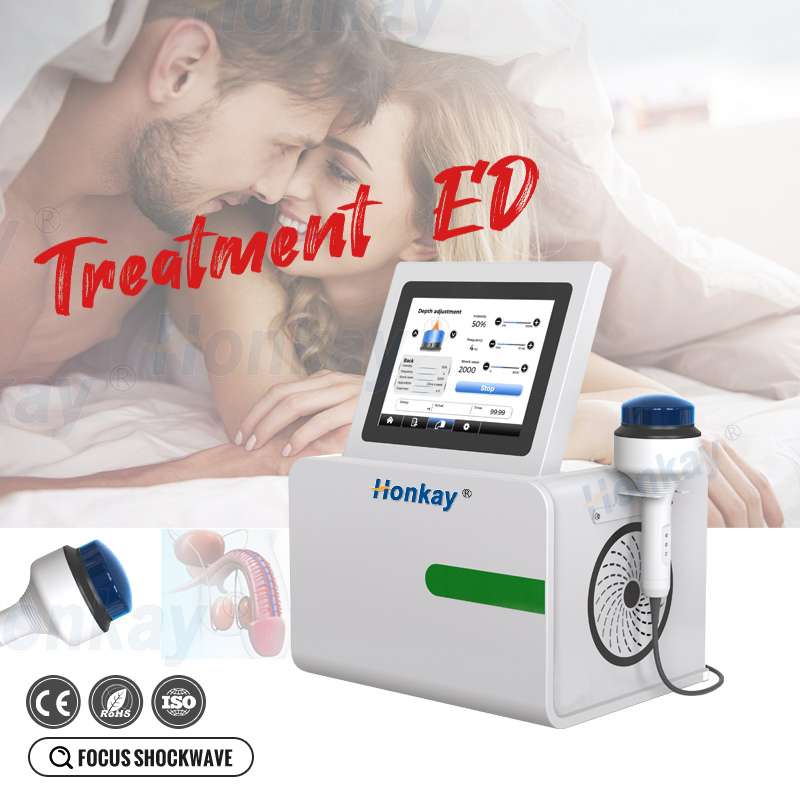
Can a clinic use it for ED treatment as well as orthopaedic cases?
Shockwave is used in both orthopaedic and urological-clinic settings, and a unit can serve both provided the protocols and the screening differ appropriately. Confirm the specific indications the supplier supports with documentation rather than relying on a marketing overlay.
What should I confirm before ordering a focused shockwave machine?
The working depth range in one consistent unit and the full adjustment travel; how energy is expressed and over what range; the pulse frequency range; whether any consumable is needed per session; the number of handpieces and spare parts availability; the per-area protocol table; the contraindication and screening list; and the written warranty terms.
Request a quotation for a focused shockwave system
Tell us which cases you actually see — chronic tendon presentations, post-injury rehabilitation, or a mixed orthopaedic list — and we will confirm whether a focused unit is the right mechanism for it, and which configuration and protocols fit. The quotation includes the depth range in a single unit, the energy and frequency ranges, the per-area protocol table and the written warranty terms.
Manager: Lisa
WhatsApp: +8613751821215
E-mail: hk6@huang-kai.com