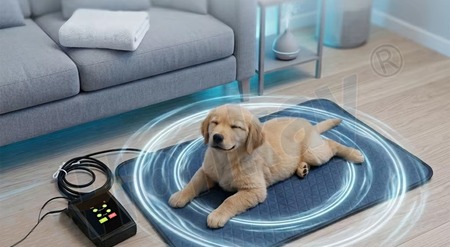
PEMF Mat for Dogs and Cats: Size, First Week and Vet Checks
A mat for a dog or cat is a different purchase from a mat for a person
The hardware is the same. A PEMF mat, a control box, a connection cable and a power adapter do not change because the user has four legs. What changes is everything around the hardware: the animal decides where it lies, it cannot tell you that a setting feels wrong, and it will not sit still for a timer. Those three facts shape every sensible decision about size, session length and placement.
This guide is written for pet owners who want to use a PEMF mat at home with a dog or a cat, and for groomers, boarding kennels and small rehabilitation rooms that want a repeatable routine. It stays with what the product manual actually states, and it flags clearly where a veterinarian should be consulted instead.
Measure the animal in its resting position
Measure the pet while it is lying down as it normally does, not while it is standing. Take the distance from the point of the shoulder to the base of the tail, then add the head if the animal stretches out rather than curls. That measurement — not the breed name — is what decides which mat size is useful.
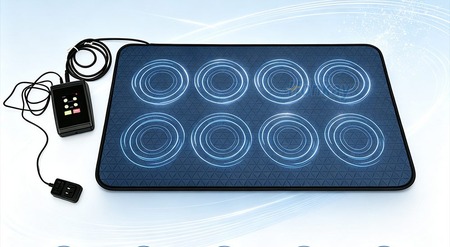
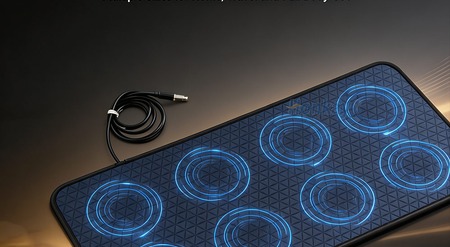
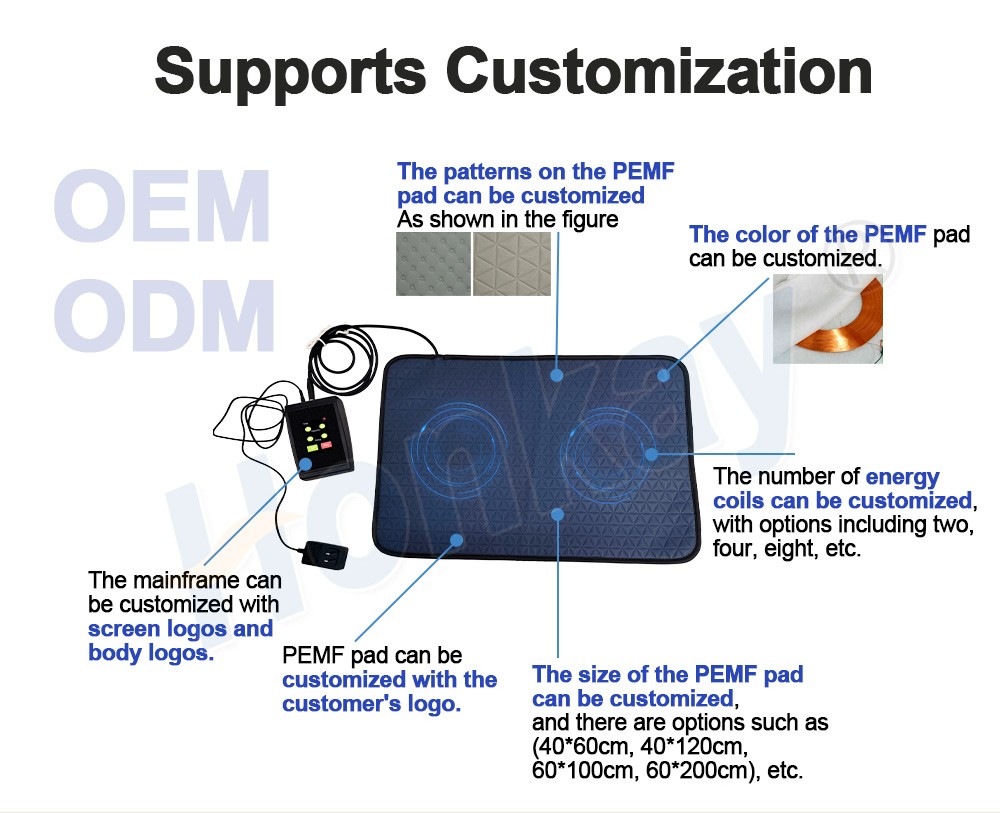
Cats and small dogs usually curl, so a 40×60 cm mat with two coils is enough for the body to rest on it with the head on the edge or just off the mat. Medium dogs that lie stretched out need the 60×100 cm mat so the whole trunk sits within the coil area. Large and giant breeds need the 60×200 cm version, and that size brings a second problem: floor space and storage, not just coverage.
| Resting length | Typical pet | Mat size | Coils | Watch for |
|---|---|---|---|---|
| Under 40 cm | Cats, small dogs that curl | 40×60 cm | 2 | Pet may leave the mat; keep sessions short |
| 40–60 cm | Medium dogs lying stretched out | 60×100 cm | 4 | Head often rests past the mat edge |
| 60–90 cm | Large dogs, two small pets in turn | 60×200 cm | 8 | Floor space, cable run, storage |
| Over 90 cm | Giant breeds | 60×200 cm, positioned lengthwise | 8 | Part of the body may still fall outside |
The first week starts at five to fifteen minutes
The manual’s guidance for a first-time user is short sessions of five to fifteen minutes at the lowest intensity level. That guidance makes even more sense for an animal, because a pet cannot describe what it feels. A first session of five minutes on level one tells you more than a thirty-minute session on level four: it tells you whether the animal stays, leaves, pants, turns around or falls asleep.
Build the routine in three steps. Session one to three: five minutes, lowest level, mat on the floor, owner sitting beside it. Session four to seven: extend towards ten minutes only if the pet stayed relaxed. Week two onwards: move towards the fifteen-minute mark, and only then consider a higher level. If the pet walks off at any point, end the session there. The device does not need to “finish the programme” for the session to be useful as a comfort routine.
A weekly routine that survives real life
A routine written down is a routine that gets repeated. The four stages below are deliberately undemanding; the point is continuity rather than intensity, and a short session kept every other day beats a long one abandoned in week two.
| Stage | What to do | What to record |
|---|---|---|
| Days 1–3 | Mat on the floor, switched off, near the pet’s usual spot | Whether the pet approaches or avoids it |
| Days 4–10 | Five-minute sessions at level one, collar removed | Minutes completed, whether the pet stayed |
| Week 2 | Ten minutes if the pet has been settled | Any change in restlessness or breathing |
| Ongoing | Same time of day, same place, pad wiped after each session | Whether the routine is still being kept |
Let the animal choose the position
The most common mistake is placing the pet on the mat. A better method is to place the mat where the pet already chooses to lie — beside the sofa, in front of the window, on its usual floor spot — and let it investigate. Cats in particular will avoid a mat that smells new or that appears in an unexpected place. Give it two or three days on the floor before the first session.
The surface matters as much as the position. The manual asks for the mat to lie flat on a hard, heat-resistant surface, and it warns against covering the device with objects that affect heat dissipation. In practice that means a flat floor or a firm mat, not a deep soft bed that swallows the pad, and no heavy blanket over the top during use.
Collars, tags and metal
The manual tells the user not to wear metal accessories during use, and not to leave large metal objects on the pad. For a pet this translates into three checks before the first session: remove the collar with its metal tag and buckle, take off any harness with metal fittings, and check that no metal bowl, crate bar or toy is resting on the mat.
Keep the mat away from strongly magnetic items as well — the manual lists bank cards, hard drives and magnetic cards, which in a home usually means the router shelf, the speaker stand or a drawer of spare keys. A pet mat that lives on the floor next to a subwoofer is a placement worth changing.
The cable is the real risk in a pet household
Every safety instruction that matters to a person matters more to an animal that chews. The connection cable runs from the pad to the control box, and the adapter cable runs from the box to the wall. Both should be routed out of reach — behind furniture, under a cable cover, or under the edge of a rug — and the control box should never be left on the floor where a pet can reach it.
The manual is clear that the pad should be connected to the control unit before the adapter is plugged in, and that a damaged cord or a damaged pad surface means the device should not be used. In a pet household, inspect the pad surface after every session. A single claw puncture is easy to miss and easy to catch if the inspection is part of putting the mat away.

Hygiene when the mat is shared
A mat used by several animals, or by an animal and a person, needs a wipe-down routine. The surface is a PU leather cover, so a damp cloth with a mild cleaner is normally enough; the manual’s storage conditions — 5 to 40 °C and up to 80 % relative humidity, away from damp environments — mean the mat should be dry before it is folded and put away.
Keep one cloth for the mat and one for the floor, and do not use the same cloth on the pad and on a grooming table. If a pet has a skin condition, ask the veterinarian whether the mat should be used at all before introducing a cleaning routine around it.
When a veterinarian should decide first
The manual’s contraindications are written for human users: cardiac pacemakers, implanted neurostimulators and other electronic implants must not be used with the device, pregnant women should consult a professional, and children should only use it after professional advice. For animals, the equivalent rule is simpler to state and harder to over-apply: ask the veterinarian before using the mat on a pet that is pregnant, recovering from surgery, wearing any implanted device, receiving treatment for a serious condition, or showing sudden changes in behaviour or mobility.
Stop the session if the animal pants, trembles, tries to leave repeatedly or becomes restless. A comfort routine that the animal avoids is not a routine worth keeping.
Frequently asked questions
Can a PEMF mat be used on a dog or a cat?
A PEMF mat is a wellness device intended for relaxation and comfort. For animals, ask a veterinarian first, especially if the pet is pregnant, recovering from surgery or under treatment for a medical condition.
Which size suits a cat?
The 40×60 cm mat with two coils is normally enough, because a cat curls and does not need full-length coverage. Measure the resting length rather than guessing from the breed.
How long should the first session be?
Five minutes at the lowest level. The manual recommends five to fifteen minutes for a first-time user at the lowest intensity, and an animal cannot report discomfort, so start at the short end.
Should the collar be removed?
Yes. Metal tags, buckles and harness fittings should come off before the session, in line with the manual’s instruction not to wear metal accessories during use.
Can the mat be left on while the pet sleeps on it?
The manual warns against continuous use for prolonged periods. Keep sessions timed, stay within the recommended duration and supervise the animal rather than leaving it unattended.
Can a thin blanket be placed over the mat?
The manual advises against covering the device with objects that may affect heat dissipation. If a cover is needed for hygiene, keep it thin and confirm the practice with the supplier first.
What if the pet walks away mid-session?
End the session. Walking away is the clearest signal available, and a shorter session the animal accepts is more useful than a longer one it avoids.
Can two pets share one mat?
They can share the mat, but not the same session. Wipe the surface between animals, and let one pet use it at a time so the session can be stopped the moment either animal becomes restless.
Buying a pet mat through Honkay
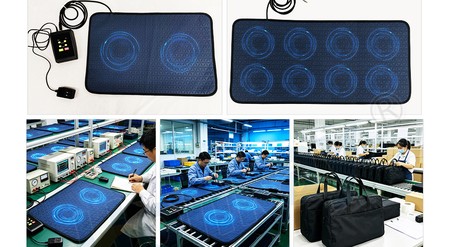
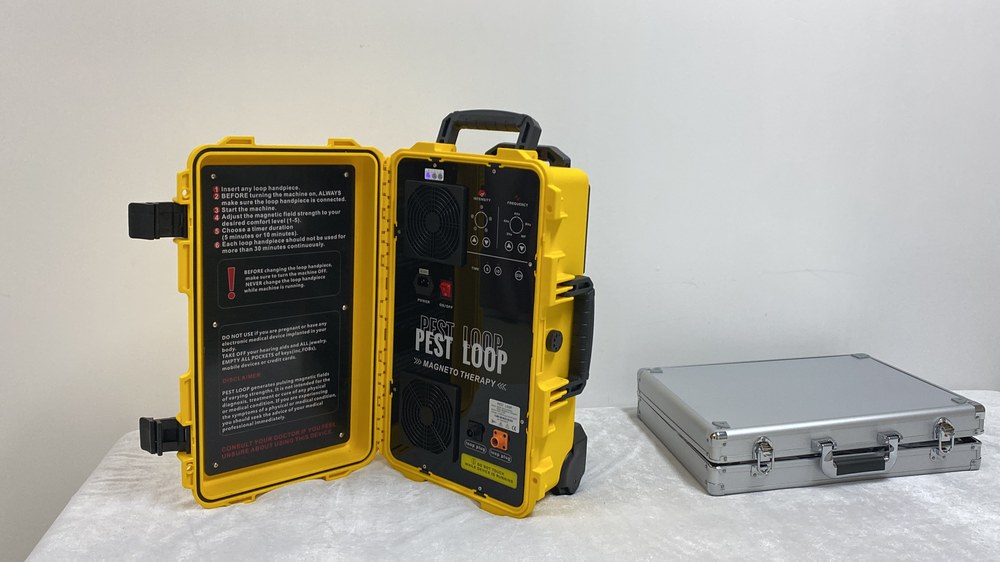
Honkay has manufactured physiotherapy and aesthetic equipment since 2005, including PEMF mats, loops and dual-channel systems, and ships with a 24-month warranty from factory shipment. The mats in this range run from 1 to 100 Hz with an intensity range of 0 to 25 Gs and are available in four sizes with 2, 4 or 8 coils. The pad surface, colour and logo can be customised for distributors and for clinics that want their own branding.
Send the Honkay team the pet’s resting length, the floor space available and whether the mat will also be used by people. That information decides the size, and it decides whether a second mat is a better purchase than one large one.
WhatsApp: +8613751821215 | E-mail: hk6@huang-kai.com | Manager: Lisa
This device is intended for adjunctive use alongside professional care, not as a replacement for diagnosis or treatment. Suitability should be confirmed with a qualified clinician; individual experience varies.