PEMF Machine Buying Guide: Gauss, Frequency and Applicator Count Explained
Short answer: Three numbers decide what a PEMF machine can actually do in your clinic — magnetic intensity (Gauss), pulse frequency (Hz), and the number and geometry of the applicators. Gauss tells you the ceiling of the device, not its quality. Frequency decides which treatment categories the machine can serve. Applicator count and shape decide how much of your appointment book the machine can cover. Everything else on a datasheet — screen size, case material, where the logo sits — is logistics, not capability.
This guide explains each number, shows the ranges that production machines actually ship with, and lists the questions to ask a supplier before you pay a deposit.
Written for clinic owners, physiotherapy practices, sports-recovery centres and distributors evaluating PEMF equipment. The specification values below are taken from the manufacturer’s own technical documentation for the Honkay (Guangzhou Huang-Kai Technology Co., Ltd.) PEST Loop, HKS-29 PRO, HKS-58A, HKS-90 and HKS-55 systems. This is equipment-purchasing information, not medical advice.
1. The three numbers, and what each one actually controls
Most PEMF datasheets are written to be read quickly, not to be compared. The same three specifications appear on every one of them, and they answer three completely different questions.
| Specification | Unit | The question it answers | What it does not tell you |
|---|---|---|---|
| Magnetic intensity | Gauss (G) | How strong the magnetic field is at its peak, and whether it can be adjusted down | Whether the field is uniform, or where that peak is measured |
| Pulse frequency | Hz | How many magnetic pulses per second the field switches | The ring/oscillation frequency inside each pulse (a separate figure) |
| Oscillation frequency | Hz | The carrier frequency inside each pulse | Anything about treatment depth on its own |
| Applicator count and geometry | cm / m | Which body regions and which body sizes the machine can treat | How long a full treatment takes |
| Power consumption | W | Electrical load and whether the clinic circuit is adequate | Treatment output — W is an input figure, not an output figure |
Two of these are routinely confused — pulse frequency and oscillation frequency — and one is routinely oversold: Gauss. Sections 2 and 3 deal with both.
2. Gauss: the number buyers read first, and why it is not a ranking
Gauss measures magnetic flux density at the applicator. It is a real specification and it matters — a machine that peaks at 1,000 G cannot deliver what a machine that peaks at 8,000 G can — but it is a ceiling, not a quality score.
Three things matter more than the peak number:
1. How low the machine can go. A professional device needs to start well below its maximum. A 1,000–8,000 G range means the practitioner can dial intensity down for a sensitive area or a first session and up for a large muscle group. A device that only offers a fixed high output forces every patient into the same dose. When you compare two machines, compare the width of the adjustable range, not the top of it.
2. Where the Gauss figure was measured. “8,000 G” measured at the coil surface and “8,000 G” measured 5 cm into tissue are not the same claim. Ask the supplier to state the measurement point. A supplier who can answer this precisely is a supplier who has the test data; one who cannot is quoting a brochure.
3. Whether the output is stable across the whole applicator range. A large 30 cm loop and a small precision loop will not deliver identical flux density at the same setting. Ask whether the control unit compensates for applicator type.
Intensity bands you will see in the market
| Band | Typical peak intensity | What it is built for | Example configuration |
|---|---|---|---|
| Entry / home | ~5,000 G, limited adjustability | Home users and very small practices | Honkay Model A — 5,000 G, no wheels |
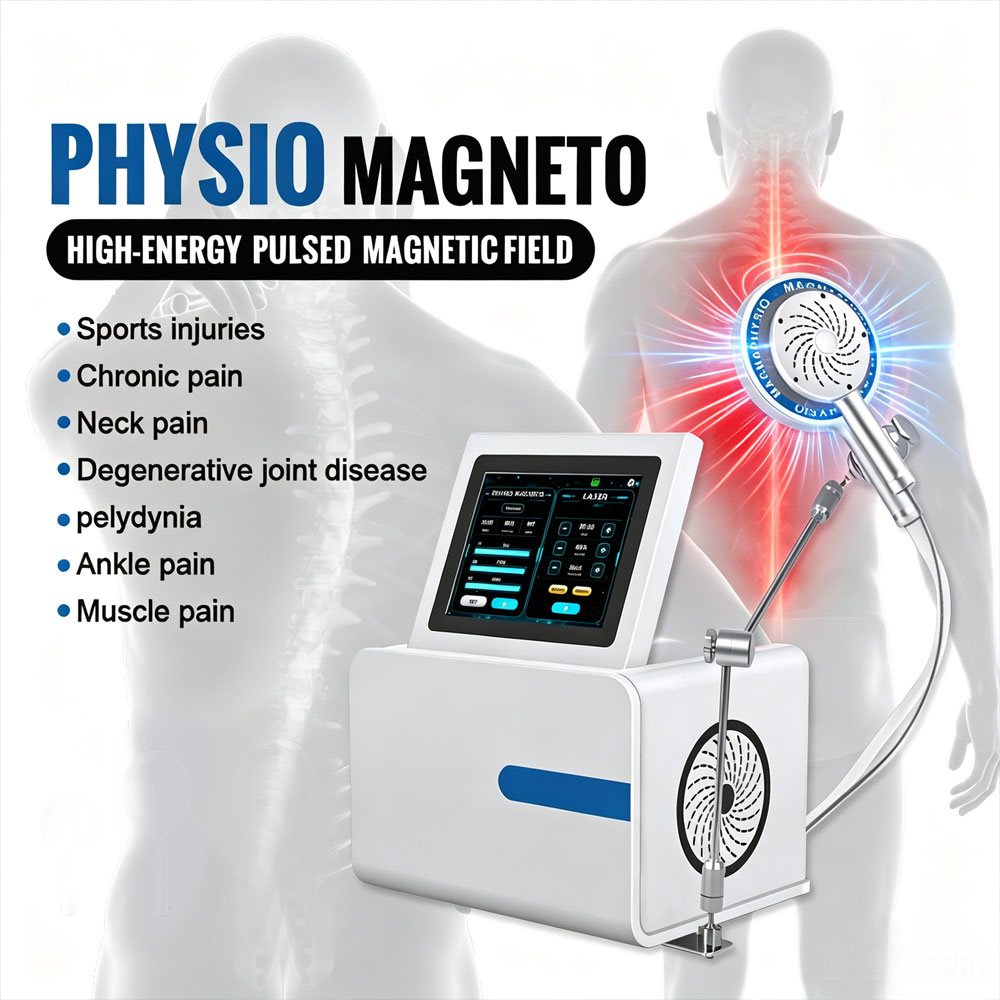
| Professional | 1,000–8,000 G, stepless or stepped adjustment | Clinics, rehabilitation centres, sports recovery | Honkay Model B (single applicator) and Model C (dual applicator), both 1,000–8,000 G |
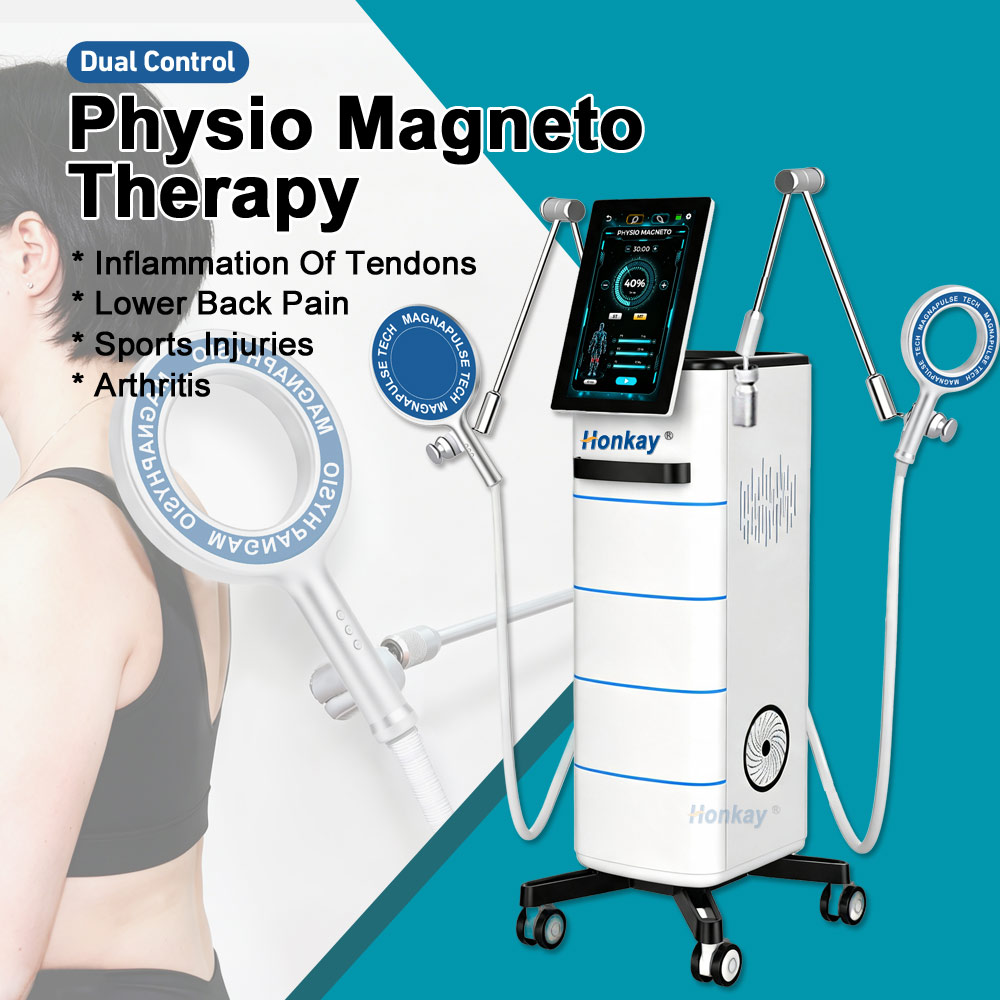
The full technical parameters of a professional dual-channel unit (Honkay HKS-29 PRO) are:
| Parameter | Value |
|---|---|
| Magnetic intensity | 1,000–8,000 Gauss |
| Pulse frequency | 1–10 Hz |
| Oscillation | 4,500 Hz |
| Power consumption | 850 W |
| Screen | 7-inch touch screen |
| Fuse | 15 A |
| IP rating | IP 31 |
| Package dimensions | 630 × 410 × 350 mm |
| Gross weight | 34 kg |
| Standard applicators | 1 × large loop, 1 × butterfly loop |
Note what the table does not contain: no depth figure in centimetres and no efficacy claim. That is deliberate. Magnetic fields pass through clothing, soft tissue and bone without requiring skin contact, which is why PEMF does not need a coupling gel and why patients do not undress — that is a physical property of the modality, and it is the honest version of the “deep penetration” claim you will see in competitor copy.
A caution about cross-category comparisons. Gauss figures are not comparable across device classes either. An FDA-approved PEMF device for osteogenesis (bone-growth) stimulation operates at a magnetic field amplitude of about 1.19 mT — roughly 12 Gauss — because its target tissue and signal design are entirely different from a physiotherapy console. A physiotherapy console quoting 1,000–8,000 Gauss and a bone-growth device quoting about 12 Gauss are not competing specifications; they are different device classes built for different indications. Compare within a class, and always against the intended use.
What to ask about Gauss
- What is the peak intensity, and at what distance from the coil was it measured?
- What is the lowest usable intensity setting?
- Does output compensate for different applicator sizes?
- Is there an independent test report on magnetic field strength (not just an EMC report)?
3. Frequency: pulse frequency and oscillation frequency are two different numbers
This is the single most common specification error in PEMF marketing. A machine will advertise “4,500 Hz” and a competitor’s mat will advertise “72 Hz”. Neither is lying — they are measuring different things.
- Pulse frequency is how many magnetic pulses are delivered per second. On a professional console this is typically a low number, adjustable: the HKS-29 PRO console runs 1–10 Hz, and its per-area presets use settings between 2 Hz and 8 Hz.
- Oscillation frequency is the ring frequency inside each pulse — the frequency at which the field oscillates during a single burst. The same HKS-29 PRO console runs at 4,500 Hz oscillation.
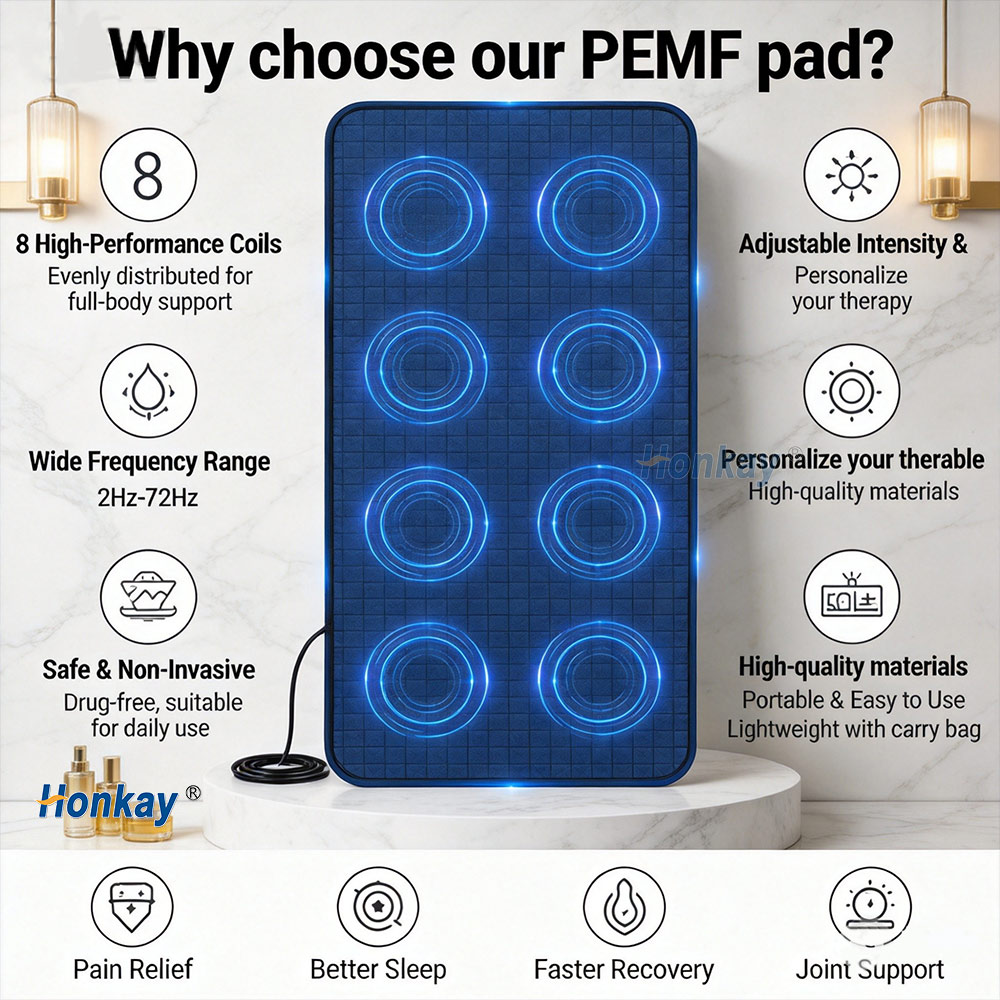
- Mat-type devices often advertise a wide frequency range across the whole device rather than a per-pulse figure. A PEMF therapy pad in the Honkay HKS-55 range is specified at 2–72 Hz, with 8 high-performance coils distributed across the pad.
| Frequency term | Typical value | What it changes | Where you normally see it |
|---|---|---|---|
| Pulse frequency | 1–10 Hz (console) | How often a pulse is delivered; this is the setting the operator changes during treatment | Console / clinical PEMF |
| Oscillation (carrier) frequency | ~4,500 Hz | The internal structure of each pulse | Console / clinical PEMF |
| Device frequency range | 2–72 Hz (pad) | The span of pulse frequencies the device can produce across its programmes | Mat / pad-type PEMF |
The buying consequence: a mat that quotes “2–72 Hz” and a console that quotes “1–10 Hz” are not comparable specifications, and neither is “better”. A pad is designed for whole-body coverage during passive sessions; a console with loops is designed for targeting specific areas with an operator present. Decide which of those two your business actually sells, then compare machines within that category.
What to ask about frequency
- Which frequency figure is quoted — pulse frequency or oscillation frequency?
- Is pulse frequency continuously adjustable, or only via fixed presets?
- What is the frequency used in the shipped presets for each body area?
4. Applicators: this is where the real cost sits
Applicators decide which treatments you can accept. A machine with one mid-size loop can treat an elbow well and a whole back badly. Because applicators are also the most expensive accessory line, the split between what ships in the box and what is optional drives the real purchase price far more than the console does.
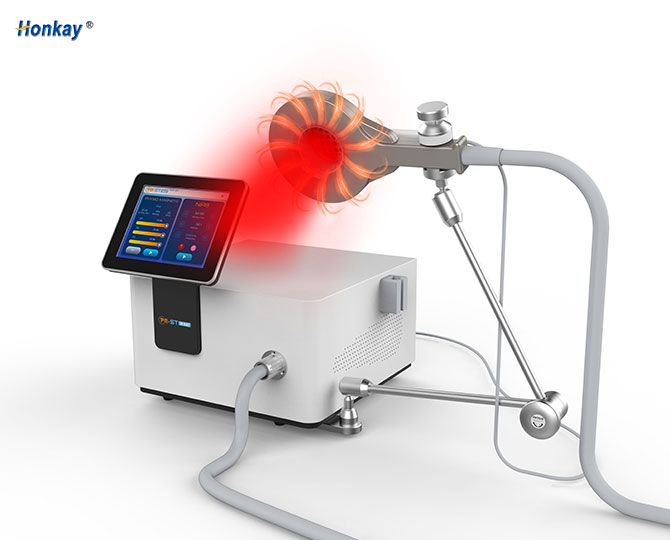
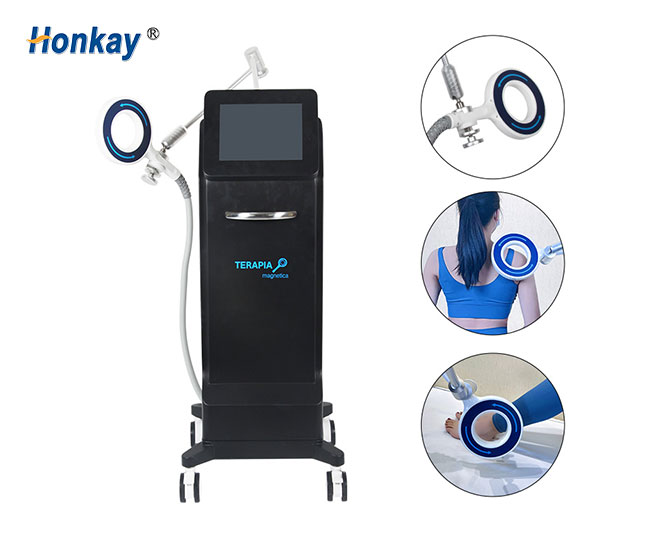
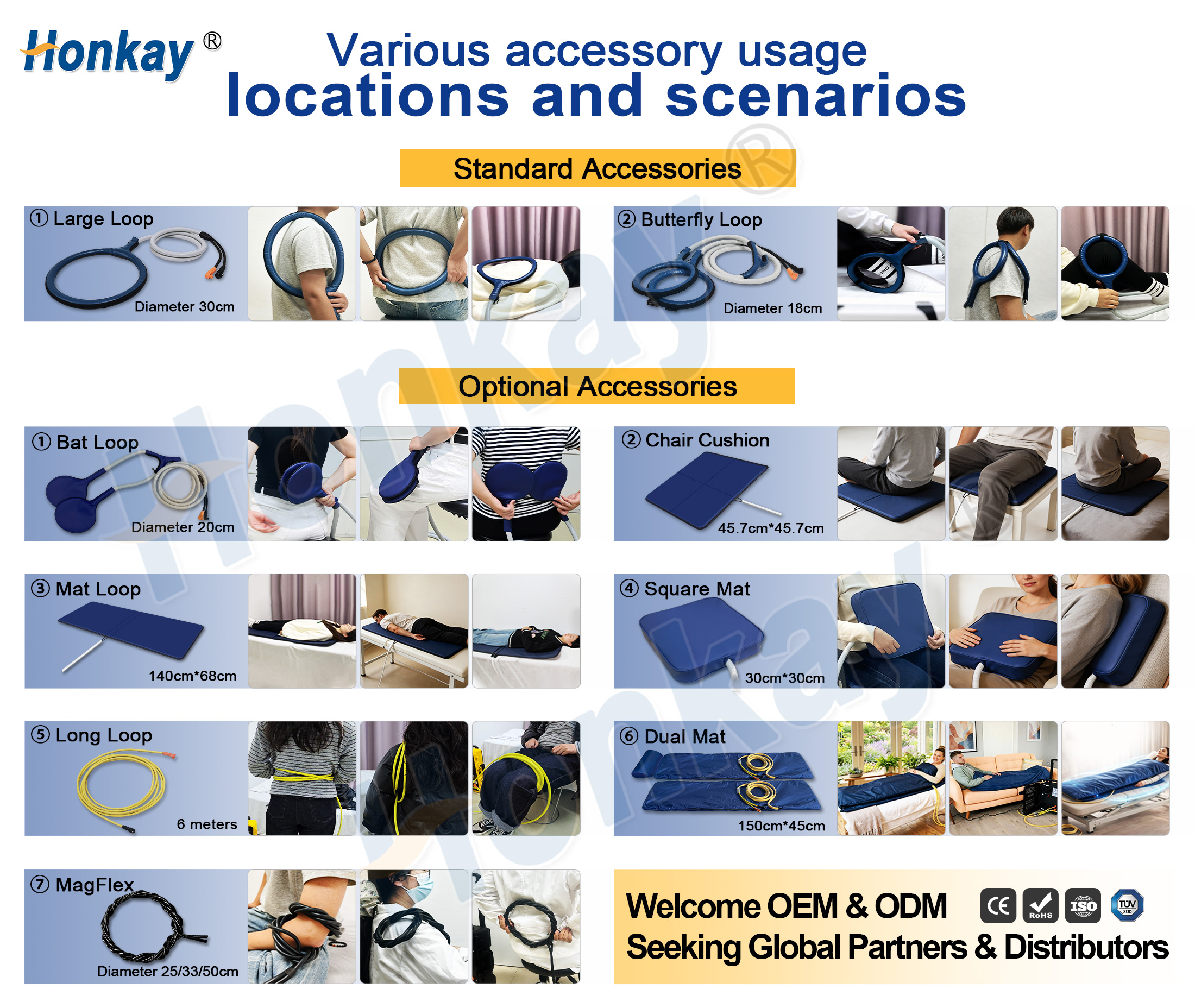
A complete loop-accessory line, as used by Honkay across its magneto systems:
| Applicator | Size | Treatment region | Standard or optional |
|---|---|---|---|
| Large loop | Ø 30 cm | Waist, abdomen, large joints, broad muscle groups | Standard |
| Butterfly loop | Ø 18 cm (double loop) | Shoulders, elbows, knees — contouring around joints | Standard |
| Bat loop | Ø 20 cm | Bilateral placement — both sides of the spine, symmetrical muscle groups | Optional |
| MagFlex | Ø 25 / 33 / 50 cm | Flexible wrap-around fixation on limbs and irregular areas | Optional |
| Square mat | 30 × 30 cm | Localised back, gluteal or abdominal placement | Optional |
| Mat loop | 140 × 68 cm | Full-body coverage for a lying patient | Optional |
| Dual mat | 150 × 45 cm | Double-layer mat, upper and lower surface working simultaneously | Optional |
| Chair cushion | 45.7 × 45.7 cm | Pelvic and seated treatment | Optional |
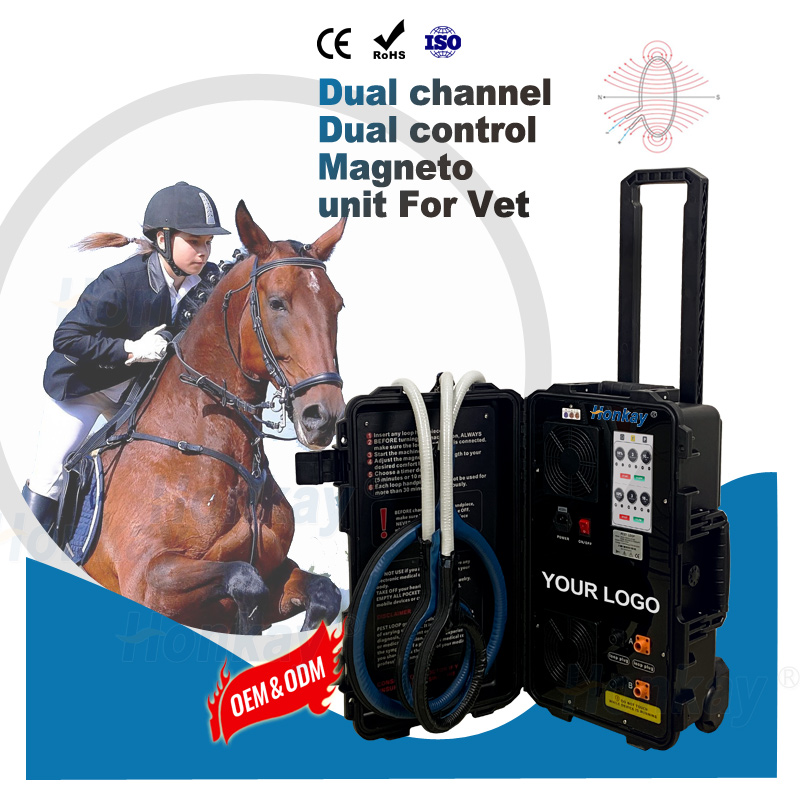
| Long loop | 6 m cable | Large-area and veterinary use, including equine | Optional |
Two points worth putting in your quotation request:
Standard versus optional is the price negotiation. A quotation that looks cheap per console often ships with two loops, and the eight items that make the machine flexible are all extras. Ask for a price list that itemises every applicator separately, then compare totals for the same accessory set.
Long-loop and mat options open additional markets. A 6 m long loop is what makes a human PEMF console usable on horses and large animals, which is a separate customer segment with its own demand — equine PEMF keywords carry materially higher commercial intent than general physiotherapy terms. If veterinary work is on your roadmap, confirm the long loop and large-area accessories before you order, not after.
What to ask about applicators
- Which applicators are included, and at what price each additional one?
- Are the loop connectors keyed or interchangeable between channels?
- Is there a documented maximum continuous use time per applicator?
- Which applicators does the supplier hold in stock for replacement?
5. Portable, tabletop or vertical dual-control? Pick by patient flow, not by power
Once intensity, frequency and applicator range are settled, the remaining decision is physical configuration — and this should be driven by how many patients you can move through the room per hour.
| Configuration | Format | Key characteristics | Best fit |
|---|---|---|---|
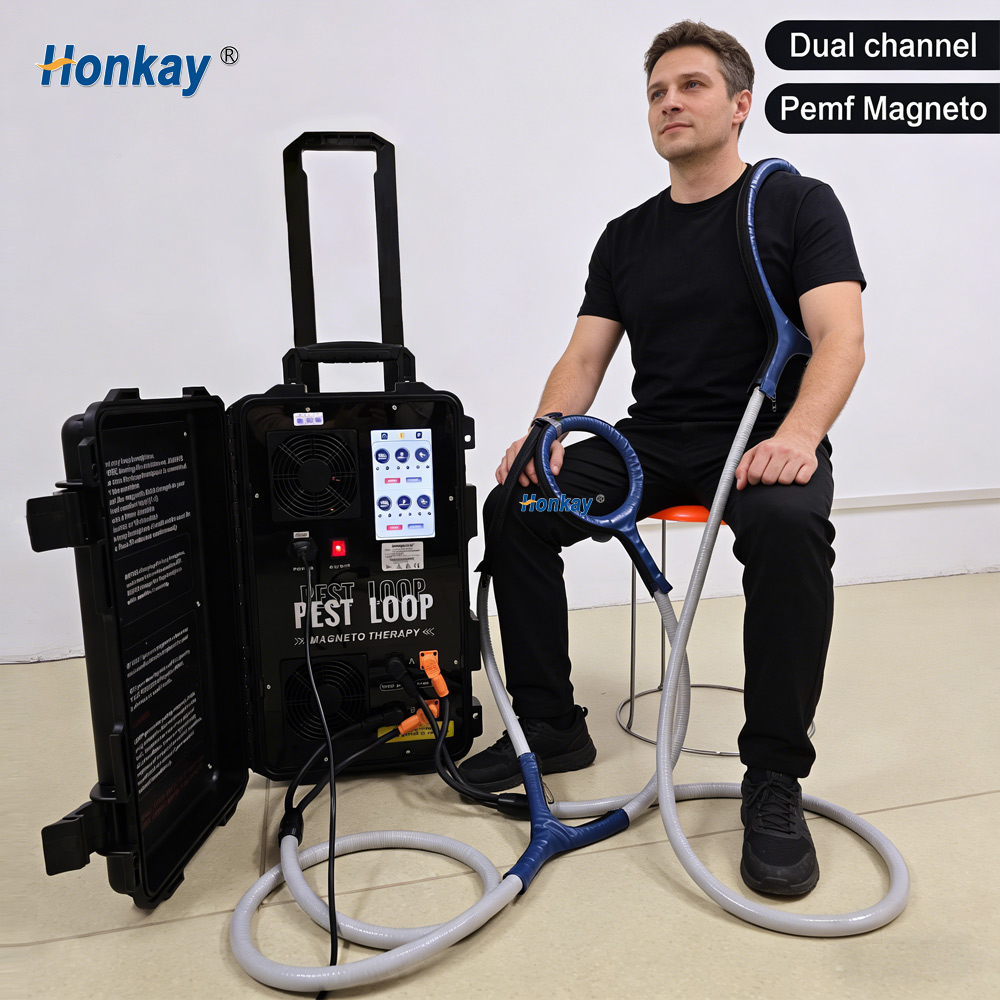
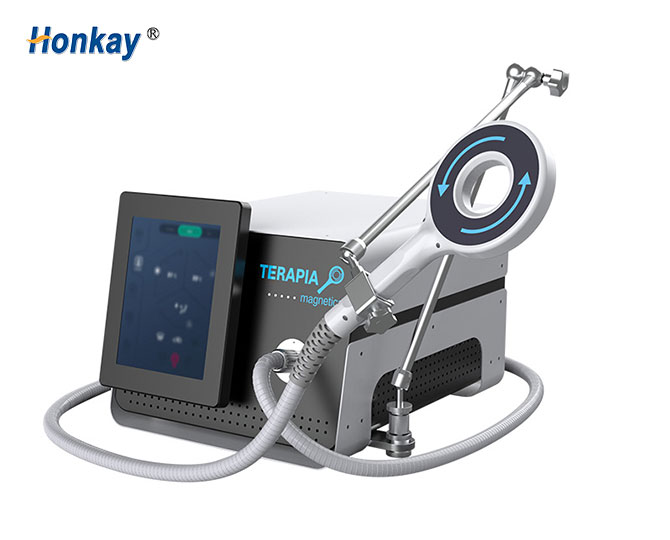
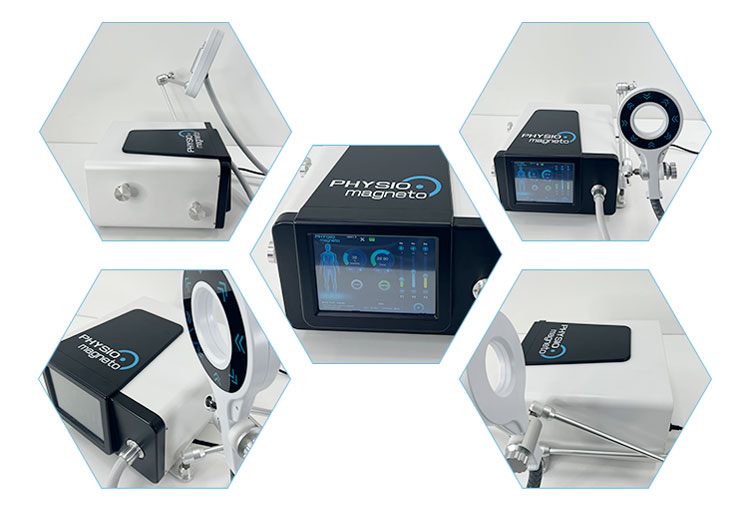
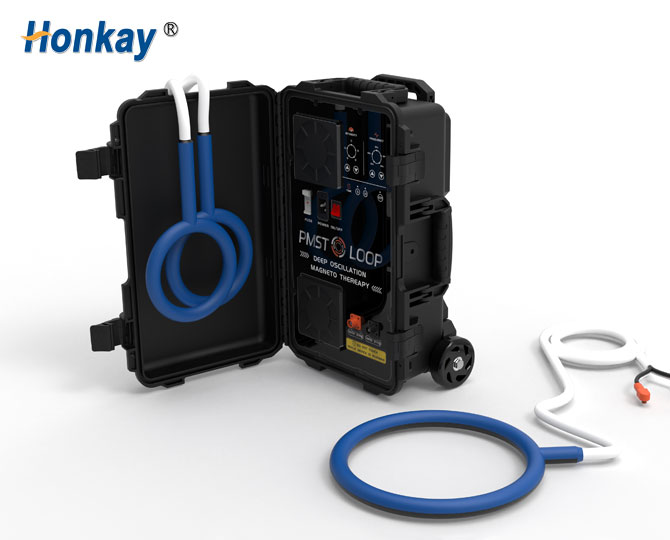
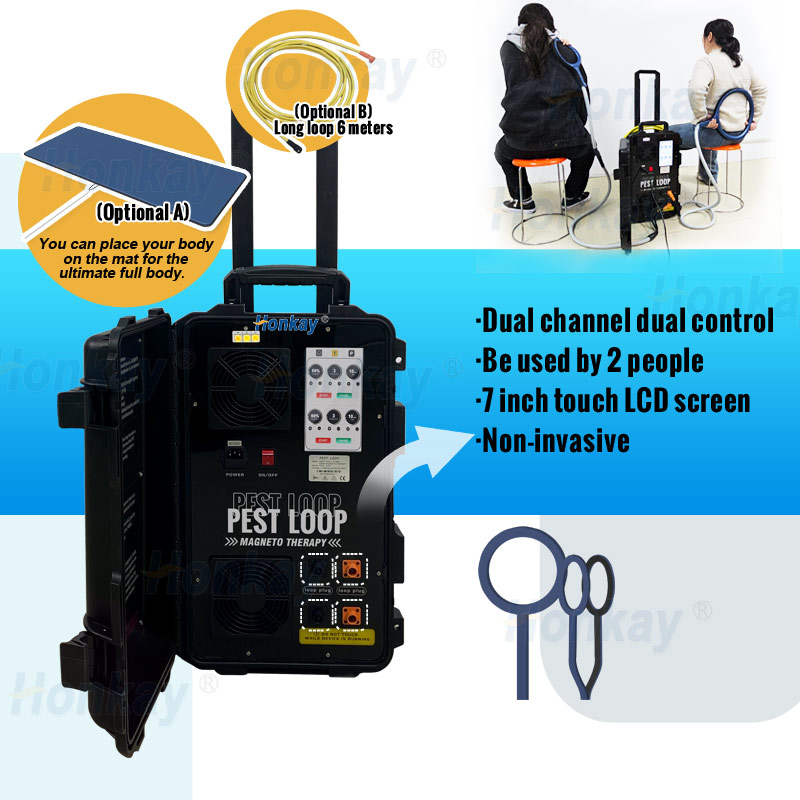
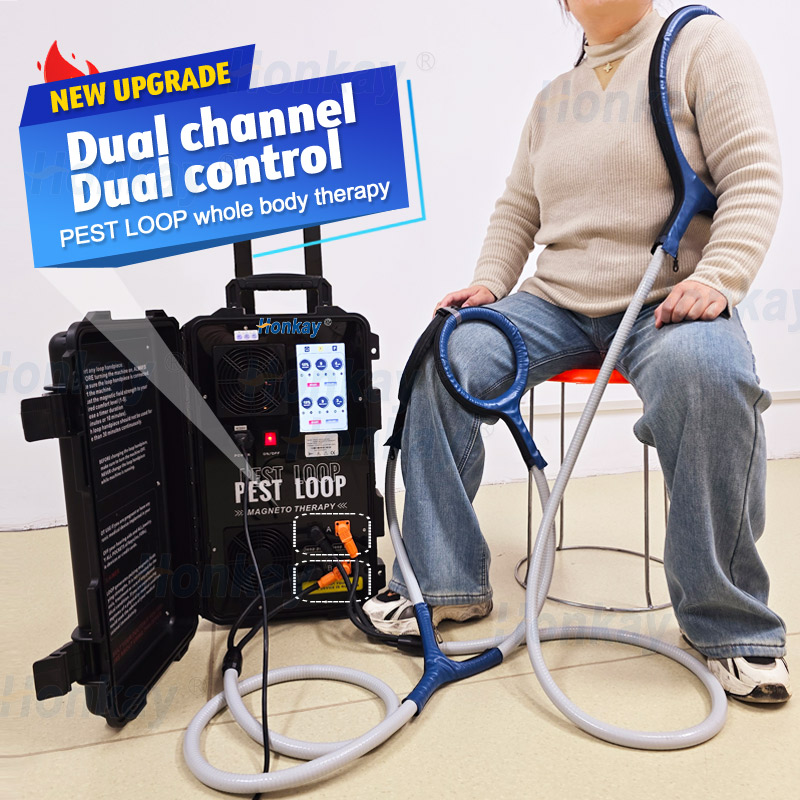
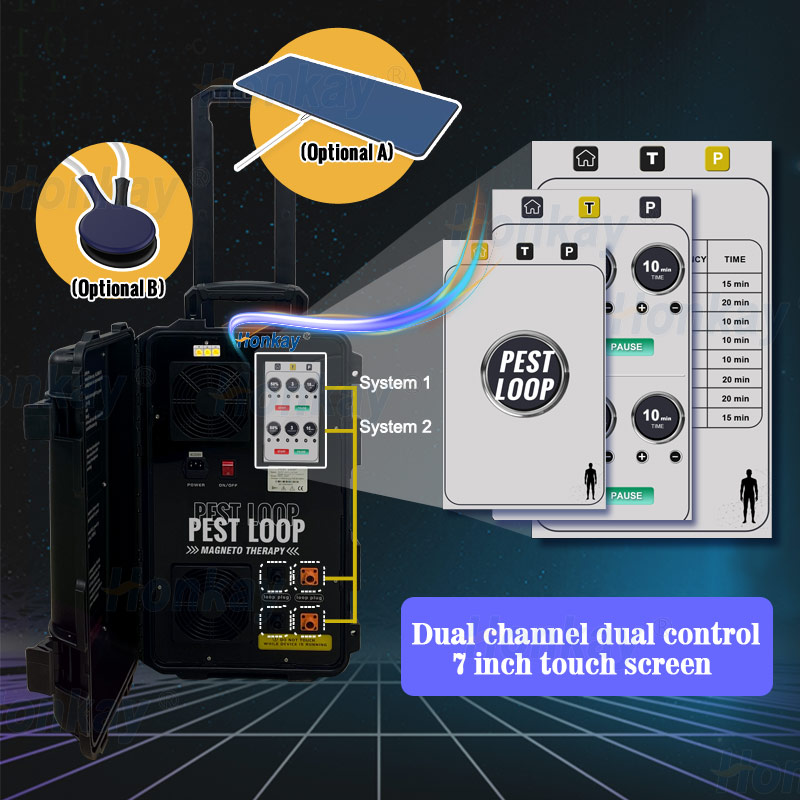
| Portable hard case | Wheeled case, current model: PEST Loop | Dual channel, dual control, 7-inch touch screen, self-contained in a wheeled case | Mobile practitioners, multi-room clinics, home-visit services |
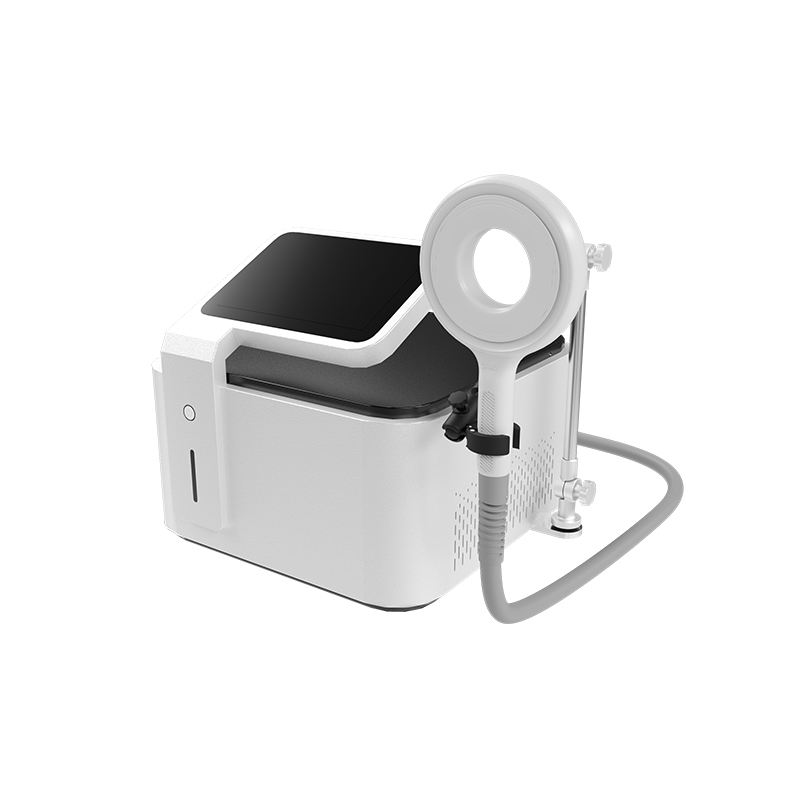
| Tabletop | Benchtop unit, current model: HKS-58A | Fixed station, compact footprint | Single-room clinics with a dedicated treatment bay |
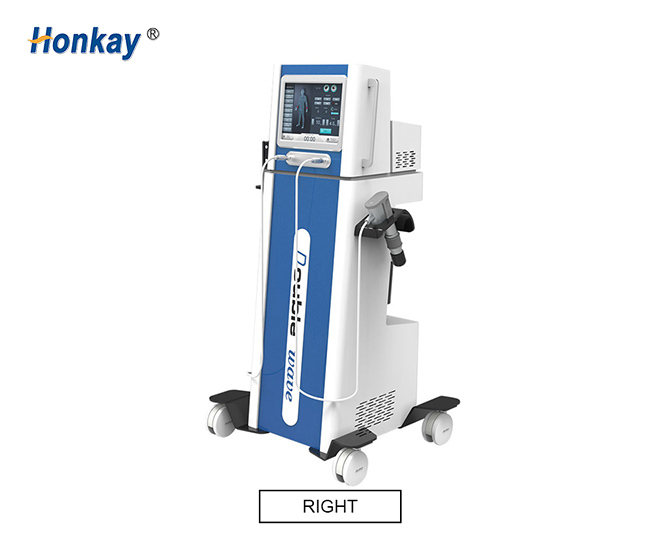
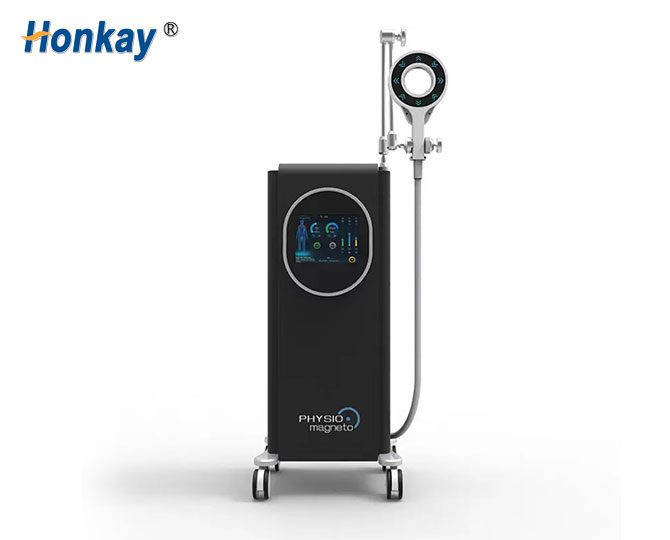
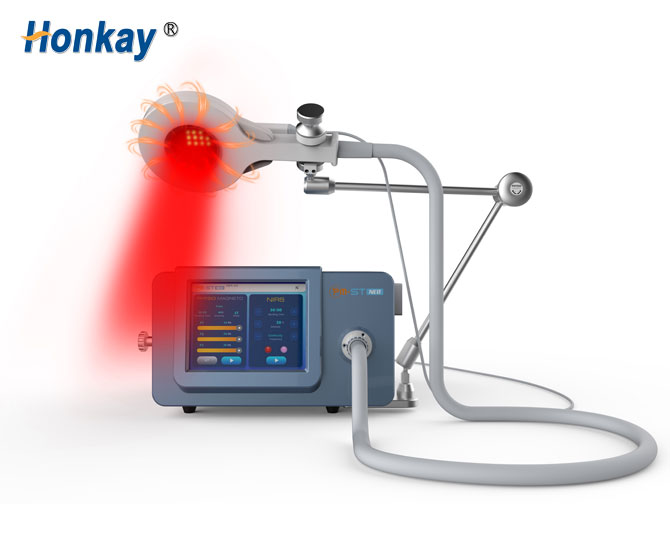
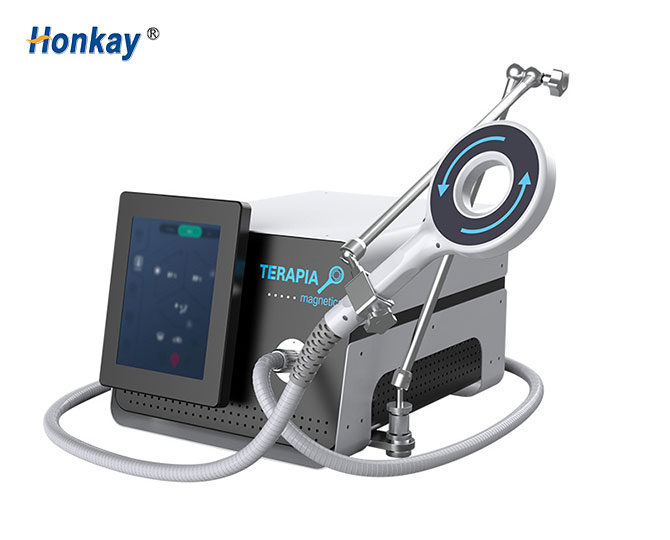
| Vertical dual-control | Upright console, current model: HKS-90 | 15.6-inch touchscreen, applicator support arms, dual control for two users or two areas simultaneously | High-volume rehabilitation and sports-recovery centres |
The horizontal specification differences are small. The operational difference is not.
A dual-control console with support arms changes the business model. Dual control means two treatment areas or two patients can be treated at once, and the articulating arms hold the applicators in position so the practitioner is not standing with an arm extended for twenty minutes. On a machine that typically runs 15–20 minute sessions, that is the difference between one and two concurrent appointments in the same room. If your constraint is practitioner time, this is the upgrade that pays; if your constraint is floor space, it is not.
What to ask about configuration
- How many channels can run simultaneously, and are they independently controlled?
- Do the applicators have positional support, or must they be held?
- What is the total packaged weight and footprint, and does it fit your existing treatment room?
- Is power supply 100–240 V for your region?
6. The protocol question: what should ship with the machine
A PEMF machine is only as useful as the treatment parameters that come with it. Ask for the protocol sheet that ships with the unit, and check that it gives, for each body area, four things: intensity level, frequency, session time, and treatment interval.
A representative extract of the recommended-parameters table supplied with the console (starting points, not fixed rules — the practitioner adjusts to the patient):
| Area | Intensity / energy level | Frequency | Session time | Interval |
|---|---|---|---|---|
| Wrist | 3 | 2 Hz | 15 min | Twice a week |
| Shoulder | 4 | 6 Hz | 20 min | Twice a week |
| Lumbar vertebra | 5 | 8 Hz | 20 min | Twice a week |
| Knee | 3 | 8 Hz | 20 min | Twice a week |
| Foot / ankle | 2 | 4 Hz | 15 min | Twice a week |
Two operational details from the same documentation that buyers regularly miss:
- Continuous-use limits on applicators. Each loop handpiece should not be used for more than 30 minutes at a time. In a busy room with a single console, that caps how tightly you can schedule back-to-back sessions on the same loop — another argument for the dual-channel configuration if throughput matters.
- Timer granularity. The console interface offers short fixed timers (10, 15 and 20 minute presets are visible on the current interface), not free-entry times. Check that the timer steps match the session lengths in your own protocol.
What to ask about protocols
- Does the machine ship with a per-area protocol sheet, and is it in my language?
- Are the presets editable, or fixed by the manufacturer?
- Does the supplier provide operator training, and in what format?
- What documentation comes with the unit for a clinic’s own records?
7. Safety: the screening questions your clinic must answer before the first patient
Every PEMF machine needs a written screening step. The contraindication list is not a marketing detail — it is the part of the manual a clinic is expected to follow, and it should be supplied in the buyer’s language.
The contraindications stated in the manufacturer’s own documentation for magneto / PEMF therapy are:
| Category | Contraindication |
|---|---|
| Vascular | Vascular diseases present in or near the treatment area |
| Infection | Local infections in the treatment area |
| Oncology | Around malignant or benign tumours |
| Anatomical | Directly on cartilage surfaces, or near the small facet joints of the spinal column |
| Implanted electronics | Directly over implanted electronic devices such as pacemakers and analgesic pumps |
| Metal implants | Areas where mechanical energy in the form of vibration may cause tissue damage, such as metal implants after a fracture |
Additional precautions that belong in your standard operating procedure:
- Metal objects near the treatment site. Depending on distance, a metal object close to the field can vibrate and heat.
- Cards and keys. ID cards, car keys and access cards placed near the magnetic ring will be damaged. This is a real, avoidable loss in a clinic setting — establish a tray for patient belongings before the session, not after.
- Implanted circuits. Strong magnetic fields can cause power failure or damage the internal chips of implanted electronic devices. Screen for pacemakers and similar devices before treatment, and document the screening.
Regulatory status is per device and per indication. A common misunderstanding among buyers is that “PEMF” as a category is cleared or approved by a regulator. It is not — clearance applies to specific devices for specific indications. The FDA’s 510(k) premarket notification database contains devices such as the pulsed electromagnetic field wrap (K202337) cleared for physical medicine, and the clearance record states the exact device and indication. When a supplier claims regulatory clearance, ask for the specific clearance or registration number, and check it against the regulator’s own database rather than accepting a certificate image.
What to ask about safety and compliance
- Can you provide the specific clearance/registration number, and the exact indication it covers?
- Which standards does the unit hold test reports against?
- Is the contraindication list supplied in my language, as a separate document?
- Is the electrical safety and EMC test report available for the specific model I am buying?
8. Eight questions to ask before you pay a deposit
| # | Question | Why it matters |
|---|---|---|
| 1 | What is the peak Gauss, and at what measurement point? | Separates a measured figure from a brochure figure |
| 2 | What is the lowest adjustable intensity? | Determines whether sensitive areas can be treated |
| 3 | Is the quoted frequency pulse frequency or oscillation frequency? | Prevents comparing two different specifications |
| 4 | Exactly which applicators ship in the box, and what does each extra one cost? | This is where the real price gap between quotations sits |
| 5 | How many channels run simultaneously and independently? | Sets your maximum patient throughput per room |
| 6 | Can you send the per-area protocol sheet that ships with the unit? | Tells you whether the machine is usable on day one |
| 7 | What is the specific regulatory clearance or registration number? | Converts a compliance claim into something verifiable |
| 8 | What are the warranty terms, the spare-parts lead time, and the training format? | Determines your cost of ownership after year one |
If a supplier can answer all eight in writing, you are dealing with a manufacturer. If two or three come back as “I will check with the factory”, keep shopping.
9. FAQ
Is a higher Gauss rating always better?
No. Gauss is a ceiling. A 1,000–8,000 Gauss machine with fine adjustment is more useful in a clinic than a fixed 8,000 Gauss machine, because most treatment areas need a mid-range dose, not the maximum.
What is the difference between pulse frequency and oscillation frequency?
Pulse frequency is how many magnetic pulses are delivered per second — typically 1–10 Hz on a professional console. Oscillation frequency is the ring frequency inside each pulse — around 4,500 Hz on the same console. Both appear on spec sheets; they are not alternatives to each other.
Why do some PEMF devices list frequencies up to 72 Hz and others only 10 Hz?
Different device classes quote different things. Mat- and pad-type devices often publish the full frequency span of the device’s programmes (for example 2–72 Hz across a pad), while clinical consoles publish the per-pulse frequency the operator sets. Compare machines within the same class.
Do patients need to undress or use a coupling gel?
No. The magnetic field passes through clothing, soft tissue and bone, and no gel or direct skin contact is required. This is one of the practical differences between PEMF and ultrasound- or radiofrequency-based modalities.
How long is a typical session?
On the current Honkay console presets, sessions run 10, 15 or 20 minutes depending on the area. Applicator handpieces carry a continuous-use limit of 30 minutes, which is worth factoring into your room scheduling.
Can one machine treat both people and horses?
Yes, with the right applicators. A 6 m long loop and large-area mat options are what make a human PEMF console usable on equine patients. Confirm the veterinary accessories are included or priced before you order, because they change the total cost significantly.
Which applicator do I need for shoulders and knees?
The Ø 18 cm butterfly loop — its double-loop geometry is designed to contour around joints. The Ø 30 cm large loop is for the waist, abdomen and broad muscle groups.
What is the single biggest mistake buyers make?
Comparing on Gauss alone. The buyers who end up with the wrong machine are usually the ones who compared peak intensity and did not compare the applicator list, the channel count, or the protocol sheet.
10. Where to go next
If you are specifying a PEMF machine for a clinic, a mobile practice, a sports-recovery centre or a veterinary service, the fastest way to a usable quotation is to send your requirements as a numbered list — one entry for each of the eight questions above — and ask for a response in the same numbering. It saves a week of back-and-forth and it tells you immediately how the supplier works.
Honkay (Guangzhou Huang-Kai Technology Co., Ltd.) manufactures the magneto / PEMF systems referenced in this guide, including the PEST Loop portable system, the HKS-29 PRO dual-channel console, the HKS-58A tabletop unit, the HKS-90 vertical dual-control console and the HKS-55 PEMF pad, together with the full applicator line — large loop, butterfly loop, bat loop, MagFlex, and the mat, dual-mat and cushion range. The company offers OEM and ODM production for distributors and holds CE, RoHS and ISO marks, with the accessory line carrying TÜV marking.
See the portable PEMF loop systems and request a specification sheet →
For the broader picture of how PEMF compares with shockwave and TECAR in the same clinic, see our comparison guide: Shockwave vs TECAR vs PEMF: which device fits your clinic.
Sources
- U.S. Food & Drug Administration — 510(k) Premarket Notification database: Pulsed electromagnetic field wrap, K202337 (Medical Specialty: Physical Medicine).
- Pulsed electromagnetic field applications: a corporate perspective
- Electromagnetic Field Therapy: A Rehabilitative Perspective in the Management of Musculoskeletal Pain — A Systematic Review
- Manufacturer technical documentation: Honkay HKS-29 PRO Dual Control Physio Magneto Therapy Machine (technical parameters, contraindications, recommended treatment parameters, cleaning and maintenance) and the Honkay PEMF accessory usage matrix, 2026 revision.